What this page lists
This page collects 8 fellowship scholarships in the United States that are open to Nigerian students. Every one of the eight is a fellowship, and every one of the eight is in the United States. None of them names Nigeria or the West African region as a requirement, and none of them carries a nationality restriction. That is the whole of it: eight awards, no nationality bar, all in one country.
Fellowships are not the same thing as a taught degree. They are usually shorter, they are often tied to a project, a department or a visiting period, and they can sit on top of a degree you already hold rather than replacing it. If you have been looking at master's and PhD listings and wondering where the shorter, project-based awards are, this is that set.
Who can apply, and at what level
The eight awards are not all aimed at the same person. Three are open at PhD level and three at postdoctoral level, so a good part of this list is for people who already hold a doctorate or are well into one. Two sit at bachelor's level and two at master's level. Two are listed at high school level, and two are short courses. Because an award can be tagged at more than one level, those figures overlap; they describe the awards, not eight separate groups of people.
For a Nigerian reader, the practical question is where you currently stand. If you finished your B.Sc or HND and you are applying for a master's, the two master's-level awards are your starting point. If you completed an M.Sc and you are now looking at doctoral study, the three PhD awards matter more. If you already have your PhD and you are chasing a visiting or research position, look at the three postdoctoral awards. The short-course and high-school entries are a smaller part of the list and will only apply to a narrow set of readers.
What the awards pay for
Four of the eight are labelled fully funded and one is labelled partially funded. Three do not state their funding position either way, so treat those three as unknown until you read the individual award page.
Where the awards do spell out what they cover, the pattern is this: three name living costs, two name travel, two name health insurance, one names accommodation, and one names research or training costs. These are what the awards say in writing on their own pages. They are not a promise that every cost you carry will be met, and they are not a promise that the same benefit appears in every award on the list. Read the funding section of each award before you build a budget around it.
The three awards that do not label their funding are worth checking directly. A fellowship that is silent on funding is not automatically unfunded, but you cannot plan around it until you have read the detail.
What the applications ask for
The requirements stated across these eight awards are modest in number but specific in kind. Three ask for letters of recommendation. One asks for an English test score, either IELTS or TOEFL. One states a minimum degree class. One asks for work experience. One asks for a research proposal. One asks for a commitment to return home afterwards.
For a Nigerian applicant, the letters of recommendation are the item that most often causes delay. Professors and heads of department move, retire and travel, and a request sent two weeks before a deadline is a request that may not be answered. Ask early, ask in writing, and give your referee the award name, the deadline and a short summary of what you are applying for.
The single English test requirement on this list is worth noting. Only one award states IELTS or TOEFL as a condition, which means the other seven do not name it in their own text. That does not mean every one of them will waive it. It means the requirement is not written into the award description on this page. Where a test is not named, check the individual award page and the university's own admission rules before you assume a waiver applies to you.
The minimum degree class requirement appears once, and the return-home commitment appears once. Both are conditions you either meet or do not, so read them before you spend money on a transcript.
Deadlines and how they fall
Five of the eight awards carry a date, and all five of those are still open. Three are undated. Five are recurring, which means they come round again rather than closing permanently.
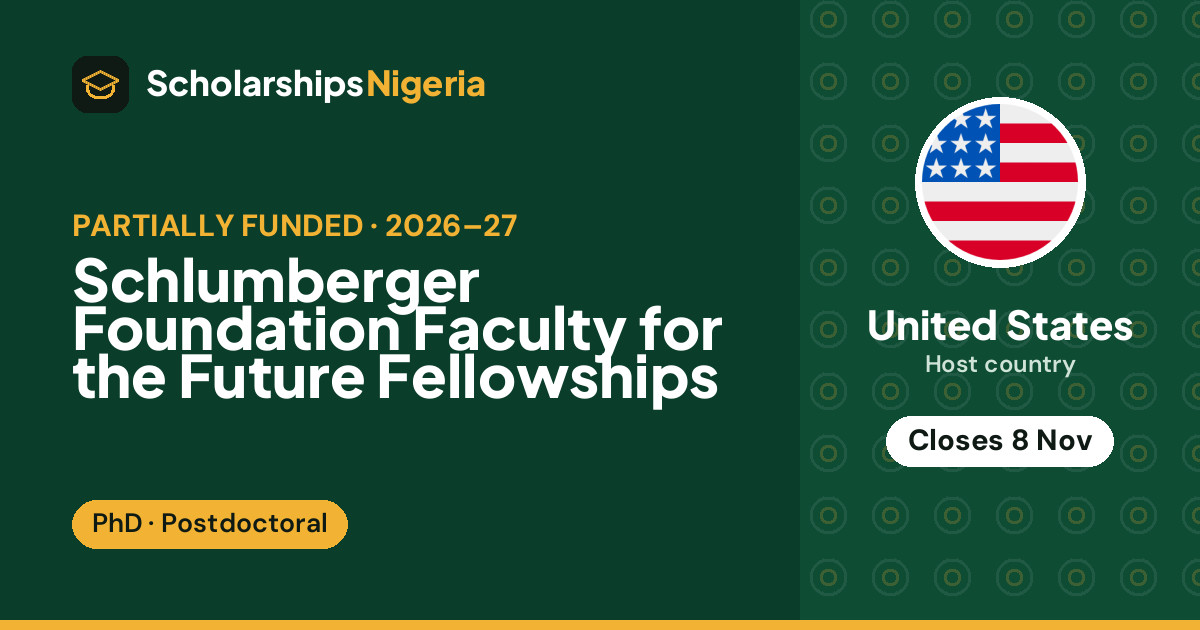
The busiest month is November, with three deadlines. October has one, and June has one. The awards closing soonest are:
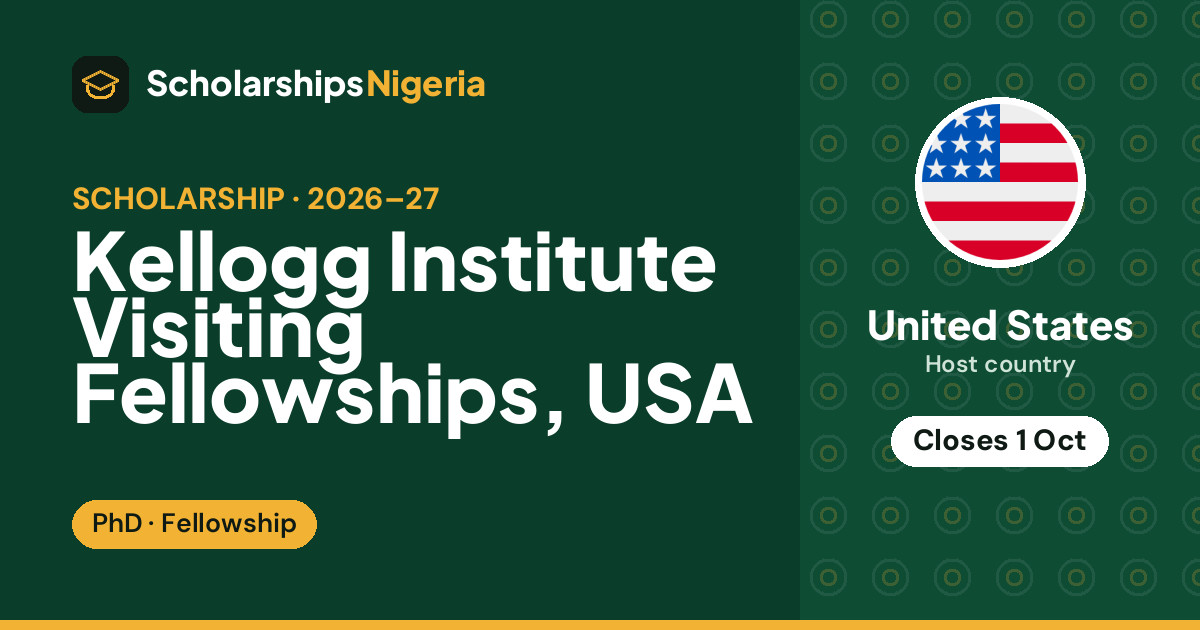
Two of those five fall in the same fortnight in November. If you intend to apply to both the ACI Foundation award and the Schlumberger Foundation award, start the documents now rather than after the first one is submitted. The Kellogg Institute award, closing 1 October, is the furthest out of the dated group and gives you the longest runway.
The three undated awards are not closed by default. They simply do not carry a stated deadline on this page. Go to the award page and check whether applications run on a rolling basis or whether a date is published elsewhere.
Providers behind these awards
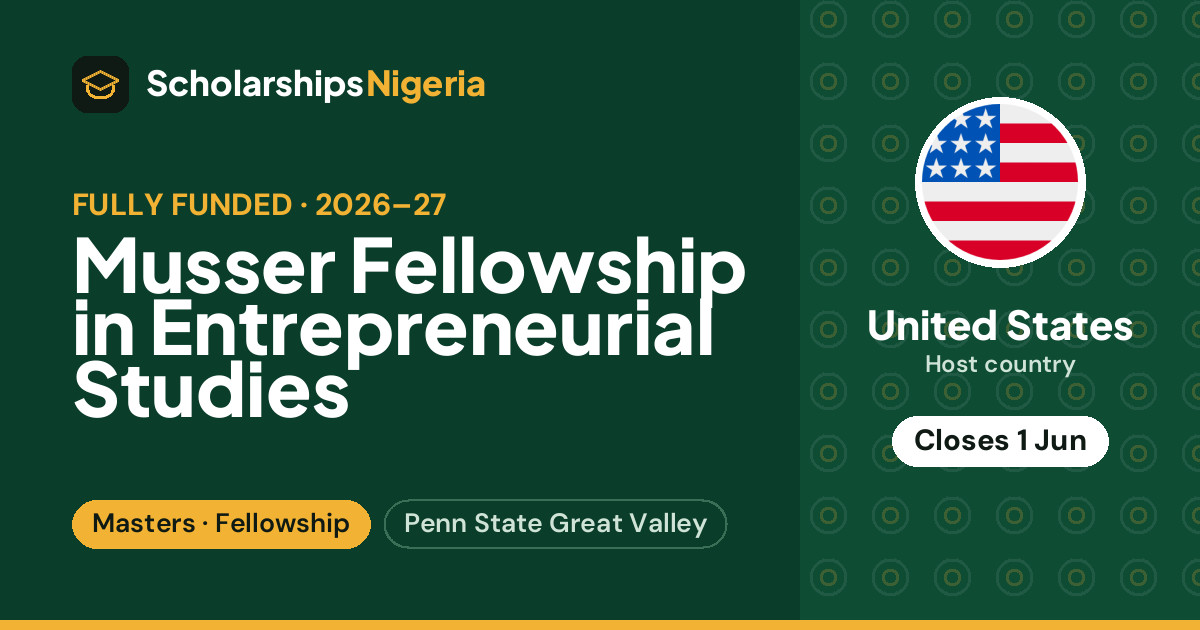
The eight awards come from a spread of providers rather than one funder. They include the Kellogg Institute for International Studies, the ACI Foundation, the Future Leaders Foundation, Harrison Middleton University, the National Endowment for Democracy, and a group listed as leading universities worldwide. One award on the list, the Musser Fellowship in Entrepreneurial Studies, is run through Penn State Great Valley.
That spread matters when you are deciding where to put your effort. A foundation fellowship and a university-hosted fellowship ask for different things and lead to different day-to-day experiences. A visiting fellowship at an institute is not the same as a fellowship attached to a master's programme. Read the provider's own description before you decide which one fits the stage you are at.
Fields and study areas
Three fields are named across the awards: Arts & Humanities, Engineering, and Natural Sciences, one award each. The remaining awards do not name a field on this page, which does not mean they are open to every subject. It means the field is not stated here. If your background is in education, law, public health, agriculture or the social sciences, check the individual award pages rather than concluding the list excludes you.
Nigerian students in the United States
Nigeria is not a small presence in American higher education. According to the UNESCO Institute for Statistics, 16,632 Nigerian students were studying in the United States in 2023, placing Nigeria second among countries sending students there. That figure covers students at all levels, not fellows alone, but it tells you the ground is already well walked. There are people ahead of you who have done the transcript runs, the courier payments and the referee follow-ups.
What to do next
Start with the two November deadlines if either fits your level, because they are the ones you can still act on this cycle. Open the award page, read the eligibility line in full, and note exactly what documents are named. Then work backwards from the deadline and give yourself at least three weeks for transcripts, courier delivery and referee responses, since those are the parts you do not control.
If neither November award fits, look at the Musser Fellowship closing 1 June or the Kellogg Institute Visiting Fellowships closing 1 October, both of which give you more time to prepare a stronger file. And if you are at doctoral or postdoctoral stage, read the three PhD-level and three postdoctoral-level awards on this list before you widen your search elsewhere.