What this page lists
This page collects 12 scholarships in China open to Nigerian students. Every one of the 12 is labelled fully funded by the awarding body, so there is no partially funded award to filter out and no fee-paying option sitting alongside them. The list is built around Chinese universities and the awards they run for international applicants.
Eleven of the 12 are open at master's level, 10 at PhD level, and eight at bachelor's level. One is a fellowship. Several awards appear at more than one level, which is why those numbers add up to more than 12. If you are finishing a B.Sc or HND and looking for a taught master's, the master's group is where most of this list sits. If you already hold an M.Sc and want a doctorate, the PhD group is nearly as large.
Who can apply
Nine of the 12 awards state that Nigerian applicants may apply. Of those nine, none names Nigeria or the West African region as a condition, and all nine carry no nationality restriction at all. That distinction matters when you are reading an award page: an award that says nothing about nationality is different from an award that names Nigeria specifically. Here, the openness comes from the absence of a restriction rather than from a named quota for Nigerian candidates.
For the remaining three awards, eligibility is not stated on the award itself. That is not a refusal and it is not an invitation. It means the page does not tell you either way, and you would need to confirm directly with the provider before spending money on a transcript or a courier.
What the awards pay for
Because all 12 are fully funded, the useful question is not whether they cover costs but which costs they name in writing. Eight of the 12 mention tuition. Seven mention living costs. Six mention accommodation, and six mention health insurance. Three mention travel, and two mention research or training costs.
Read those as what the award documents say, not as a promise about your own offer. A fully funded label on a listing page can mean tuition plus a monthly stipend, or it can mean tuition plus a place in a shared dormitory. The benefit breakdown above tells you how many awards put each item in their own text. Where an award does not name travel, do not assume a flight is included.
Subjects on the list
The subject spread is broad rather than concentrated in one faculty.
- Arts & Humanities — 4 awards
- Business & Management — 4 awards
- Economics & Finance — 4 awards
- Agriculture — 3 awards
- Education — 3 awards
- Engineering — 3 awards
- Law — 3 awards
- Medicine & Health Sciences — 3 awards
- Public Policy & Development — 1 award
- Social Sciences — 1 award
If your background is in engineering, agriculture, law or the health sciences, there is a defined group to work through. If you are coming from public policy or the social sciences, the choice is narrower and you should expect to compete for a single award rather than pick between several.
What the applications ask for
The requirements are consistent enough to plan around. Eight of the 12 awards ask for letters of recommendation. Seven ask for an English test score, either IELTS or TOEFL. Three ask for a research proposal, and three require you to hold an admission offer before you apply. Two ask for work experience.
For a Nigerian applicant, the recommendation letters and the English test are the two items that take longest to arrange. Lecturers you want to write for you may be on strike, on leave, or simply slow to respond to email, so ask early and ask more people than you need. On the English test: seven awards state the requirement, which means five do not state it on the award page. That is not the same as a waiver. Confirm with the university whether your WAEC or NECO English result, or a medium-of-instruction letter from your department, is accepted in place of IELTS.
The three awards that require an admission offer first run on a different clock from the rest. You cannot submit those until a Chinese university has already admitted you, so the admission application becomes your real deadline.
Deadlines and how they fall
Eight of the 12 awards carry a stated date, and all eight are still open. Eight are recurring, meaning the same award returns on roughly the same calendar each year. Four are undated, so you would need to check the provider's page for the current cycle.
The busiest months are May, with four deadlines, then April with two, and December with one. That clustering is worth noting: if you plan to apply in the April–May window, you may be assembling several applications at once, each wanting recommendation letters and transcripts from the same people and the same registry office.
The awards closing soonest are:
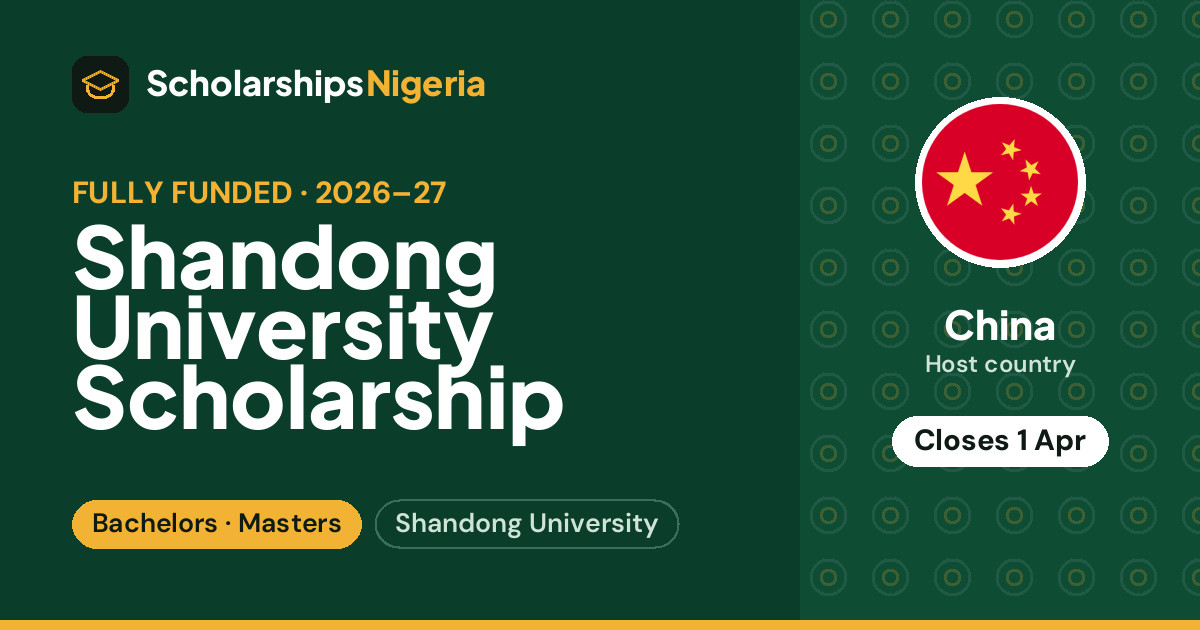
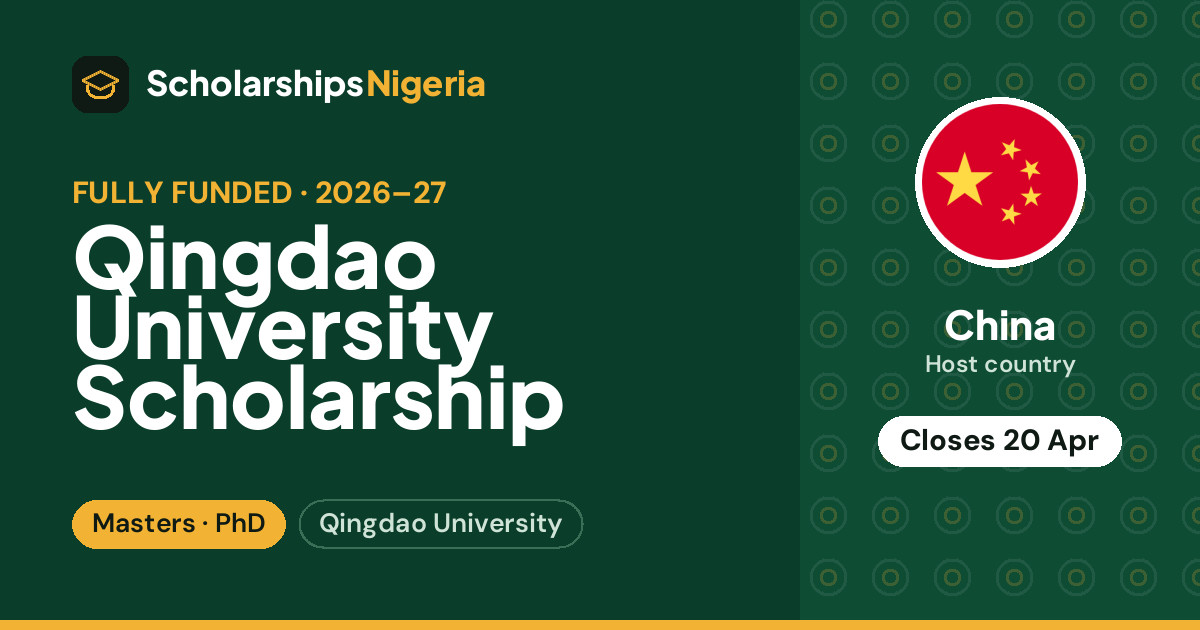
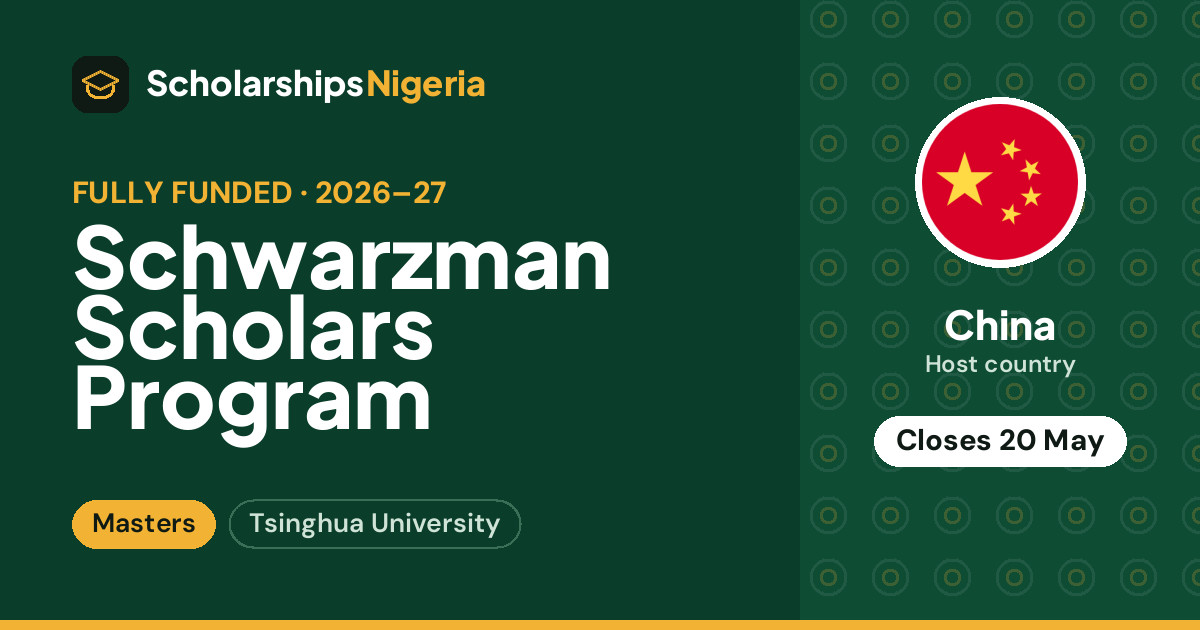
The Yenching Academy award at Peking University is the nearest deadline on the page. The Shandong, Qingdao and Yangzhou awards sit in the April–May cluster, and the Schwarzman Scholars Program closes after them in May.
Who runs these awards
The providers named on this page include Peking University, Shandong University, Central South University, Yangzhou University, and grouped listings for Shanghai universities and Beijing universities. Tsinghua University runs the Schwarzman Scholars Program.
Some awards are institution-specific and tied to one campus. Others are grouped, which means the listing covers more than one university and you will need to open it to see which institutions are inside. Two awards on the page state how many places they offer: the Qingdao University award names 20 places at PhD level and 10 at master's level, and the Schwarzman Scholars Program names up to 140.
What to do next
Start with the deadline you can still meet. If the Yenching Academy deadline is realistic for you, work on it first. If not, the April and May awards give you a longer runway for recommendation letters, transcripts and an English test booking.
Then decide your level. A bachelor's applicant has eight awards to read; a master's applicant has 11; a PhD applicant has 10. Read the eligibility line on each award before you read anything else, and treat the three awards that do not state eligibility as a question to put to the provider rather than an assumption in your favour.
Finally, budget your document costs. Transcripts, courier fees and test registration are paid by you, in naira, before any award decision is made. Apply to the awards where the requirements match what you can actually produce in the time available, and leave the rest for the next cycle.