What this page lists
This page collects 184 fully funded scholarships that Nigerian students can apply for. Every award here is labelled fully funded by the body offering it, which in practice means the award is designed to cover the main costs of study rather than a token contribution. That label matters because it is the difference between an award that pays your tuition and one that only shaves a little off it.
The list is not limited to one country or one level. It runs across undergraduate, master's, doctoral and postdoctoral study, and it includes fellowships, short courses and a small number of high school places. If you are applying from Nigeria with WAEC or NECO results, a B.Sc or HND, or an M.Sc already in hand, there is something on this page written for your stage.
What the awards pay for
Fully funded does not mean the same thing from one award to the next. The brief behind this page counts what each award states in its own text, and the pattern is clear.
- Tuition: 117 awards name it.
- Living costs: 99 awards name it.
- Travel: 61 awards name it.
- Health insurance: 51 awards name it.
- Accommodation: 50 awards name it.
- Research or training costs: 32 awards name it.
- A settling-in or arrival grant: 4 awards name it.
Read those numbers as what the awards say in writing, not as a promise that every cost you will face is covered. An award that names tuition and living costs but not travel still leaves you paying for a flight. Before you apply, open the award page and check the line items against your own budget: visa fees, transcripts, courier charges and the first month's rent before any stipend lands.
Which study levels are on the list
Master's study dominates, which reflects where most Nigerian applicants are when they start searching.
- Masters: 130 awards.
- PhD: 90 awards.
- Bachelors: 57 awards.
- Fellowship: 23 awards.
- Postdoctoral: 16 awards.
- High School: 7 awards.
- Short Course: 6 awards.
Some awards sit at more than one level, so the totals above do not add up to 184. A master's award may also be open to doctoral candidates, and a fellowship may take both. If you hold a B.Sc and are weighing a taught master's against a research degree, both routes are represented here.
Where the awards are
The United States and the United Kingdom lead the list, with 26 and 25 awards respectively. China follows with 12, Australia with 11 and Canada with 10. Italy has 9, Japan and Switzerland have 8 each, and Belgium, Germany and the United Arab Emirates have 7 each. Russia has 6, Thailand 5, and Brazil, Denmark, Saudi Arabia and Singapore have 4 each. France, the Netherlands, New Zealand, Norway, Sweden and Turkey have 3 each. Austria, Qatar and Spain have 2 each, and Hungary, Ireland and Romania have 1 each.
That spread matters for a practical reason. Tuition-free and stipend-bearing awards exist well beyond the two countries most Nigerian students default to, and the competition in some of the smaller destinations is thinner. If your field is engineering, medicine or the natural sciences, look at the country list before you decide where to send your documents.
Fields of study
Business and Management carries the largest share at 18 awards, followed by Arts and Humanities at 16. Engineering and Medicine and Health Sciences have 13 each. Social Sciences has 10, Law 9, Economics and Finance 8, and Education and Natural Sciences 6 each. Agriculture, Computer Science and IT, and Public Policy and Development have 4 each, and Energy and Environment has 2.
Professional fields are well represented, which suits applicants coming from HND and B.Sc backgrounds in accounting, law, engineering and health. Research-heavy fields appear too, but they usually ask for a supervisor and a proposal, which is covered below.
Can a Nigerian applicant apply?
This is the question the page exists to answer, and the brief gives it directly. Of the 184 awards, 91 are open to Nigerians. Within that group, 7 name Nigeria or the region in their eligibility text, and 84 carry no nationality restriction at all. Those two figures add up to the 91; they are not separate groups stacked on top of each other.
A further 93 awards do not state their eligibility on the award page. That is not a refusal. It means the information is not on the page we hold, and you will need to check the provider's own rules before you spend money on a transcript or a courier. Treat an unstated eligibility rule as something to confirm, not something to assume.
What the applications demand
The requirements below are counted from what the awards themselves state. They tell you what to prepare before a deadline arrives rather than after.
- Letters of recommendation: 98 awards ask for them.
- An English test score (IELTS or TOEFL): 74 awards ask for one.
- A minimum degree class: 37 awards state one.
- A research proposal: 36 awards ask for one.
- Work experience: 14 awards ask for it.
- An admission offer first: 13 awards require it.
- A commitment to return home afterwards: 3 awards state it.
Two of these deserve attention from a Nigerian applicant. First, recommendation letters: 98 awards want them, and referees in Nigerian universities and workplaces are often slow. Ask early, give them your CV and your statement, and follow up in person rather than by email alone. Second, the English test: 74 awards name IELTS or TOEFL. Some providers waive the test where your degree was taught in English, but the brief does not record which ones, so check the individual award page rather than assuming a waiver.
Only 13 awards require an admission offer before you apply for the funding. That means for the large majority, the scholarship application and the university application run in parallel, and you should not wait for an admission letter before starting.
Deadlines and how they fall
Of the 184 awards, 67 carry a stated date and 117 are undated, meaning the page does not show a closing date. 64 are still open, and 64 recur, so a missed cycle is often not a permanent loss. October is the busiest month with 10 deadlines, followed by May and January with 8 each.
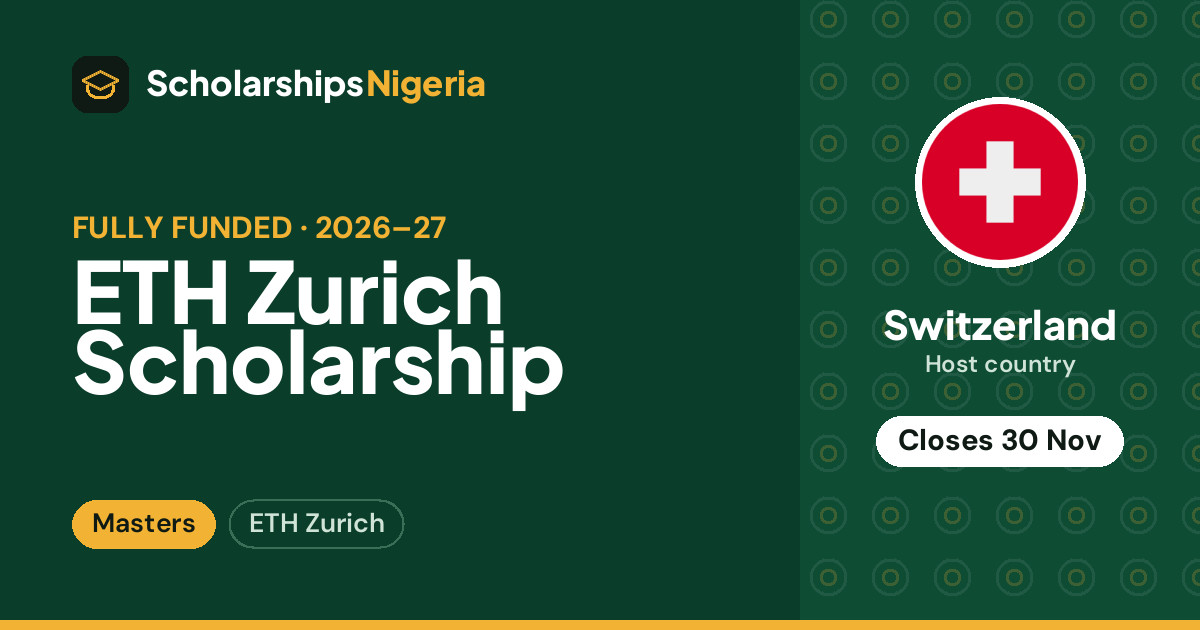
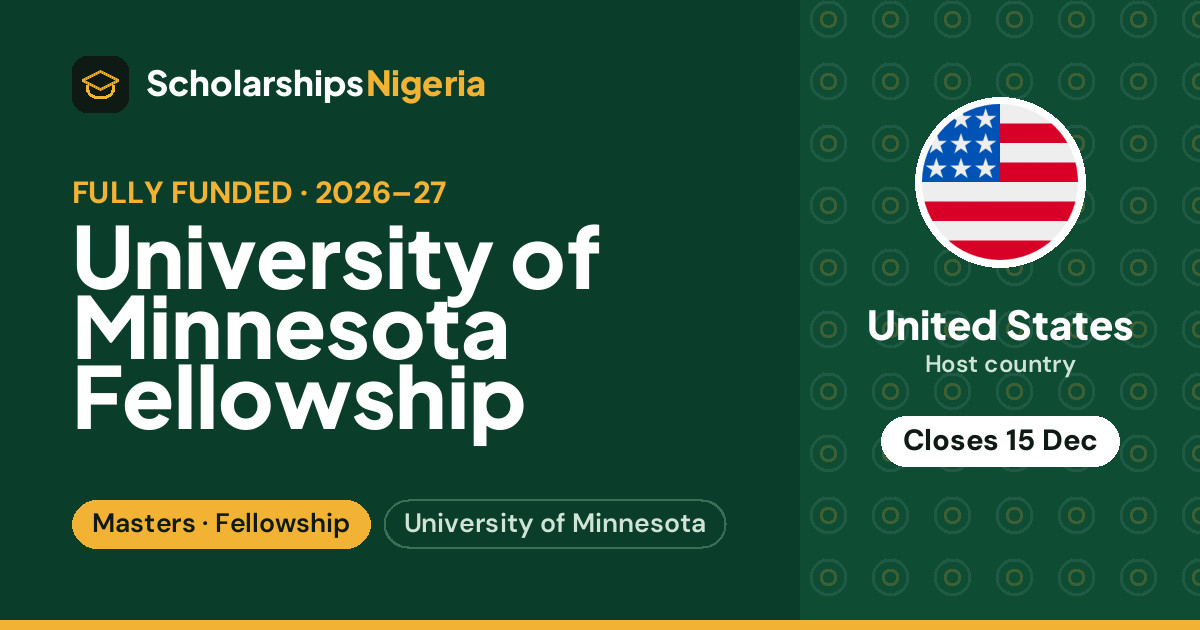
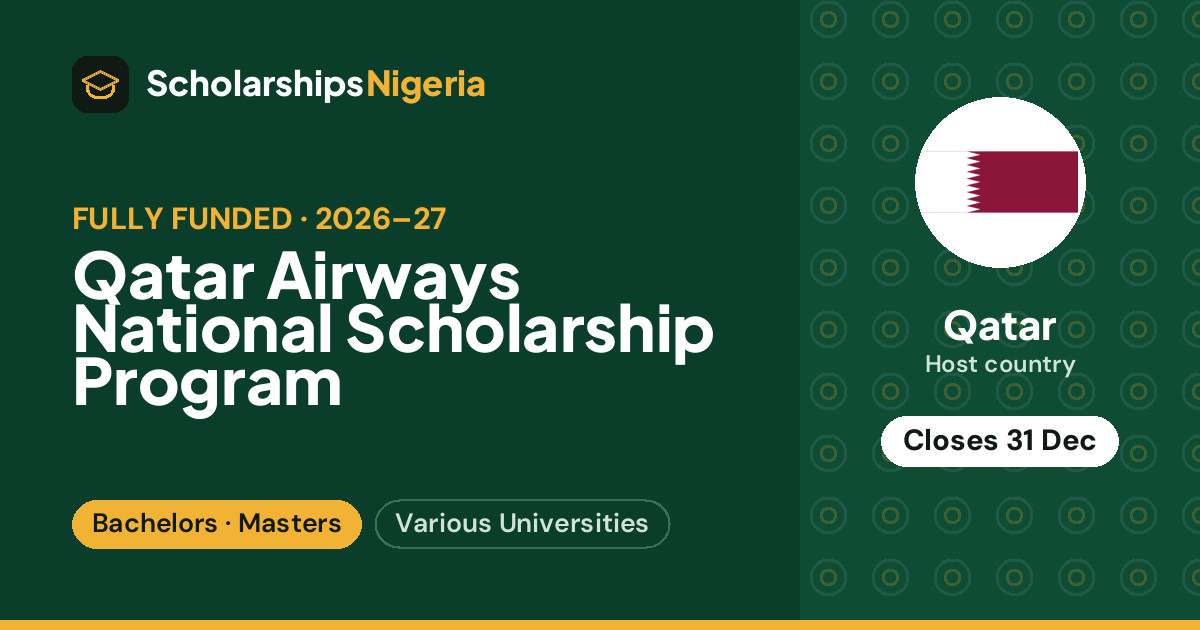
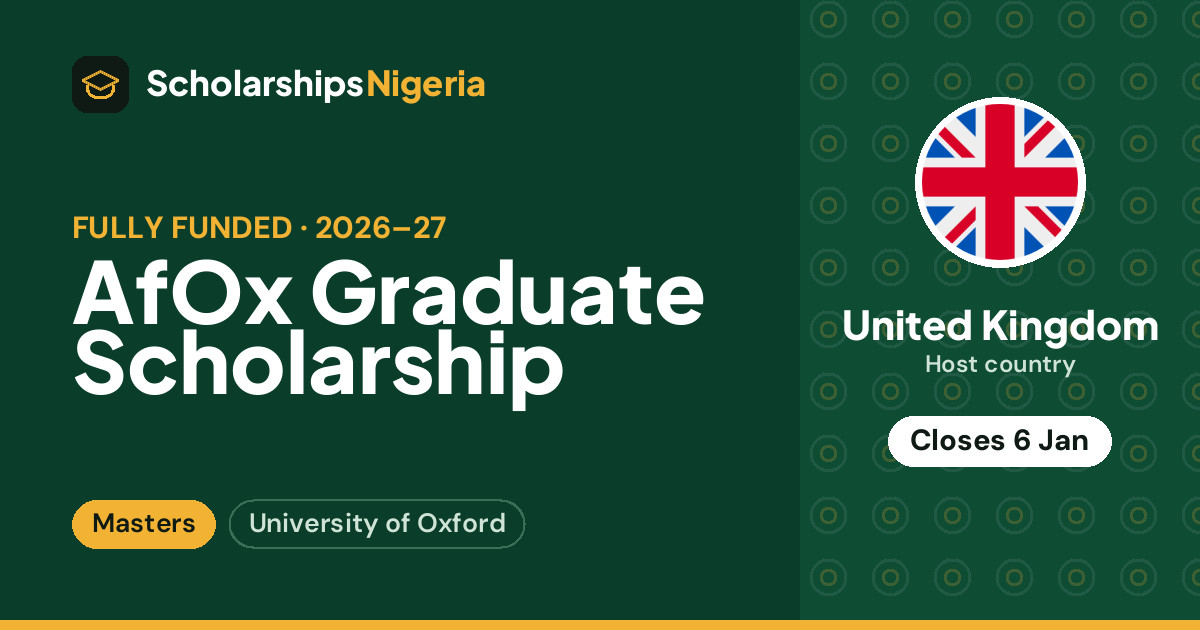
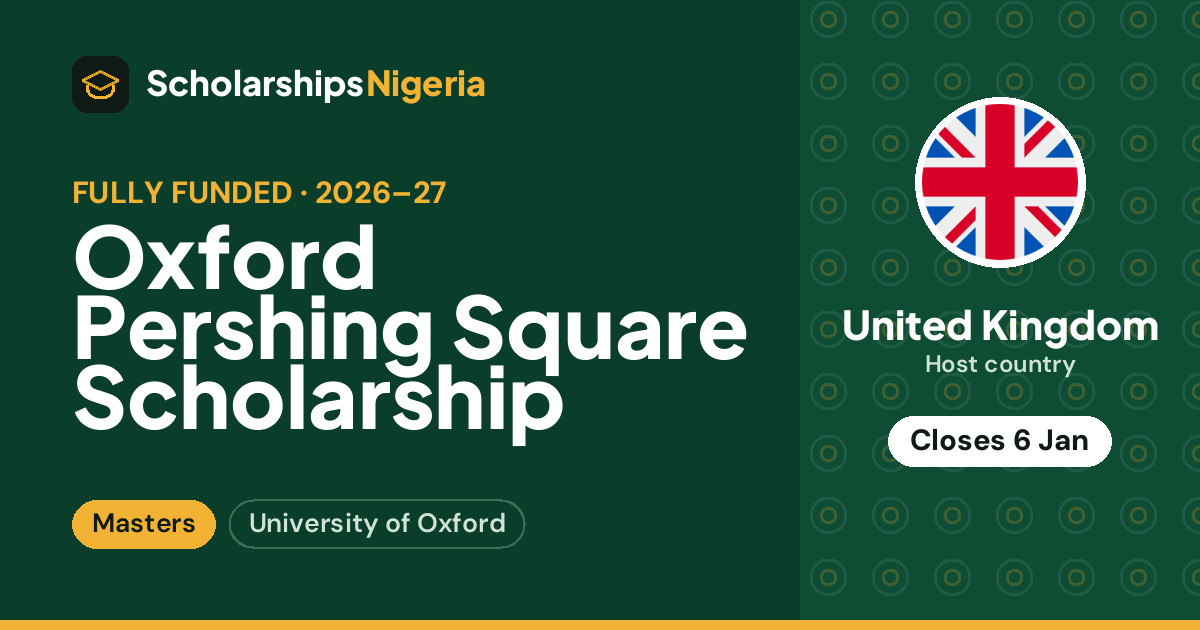
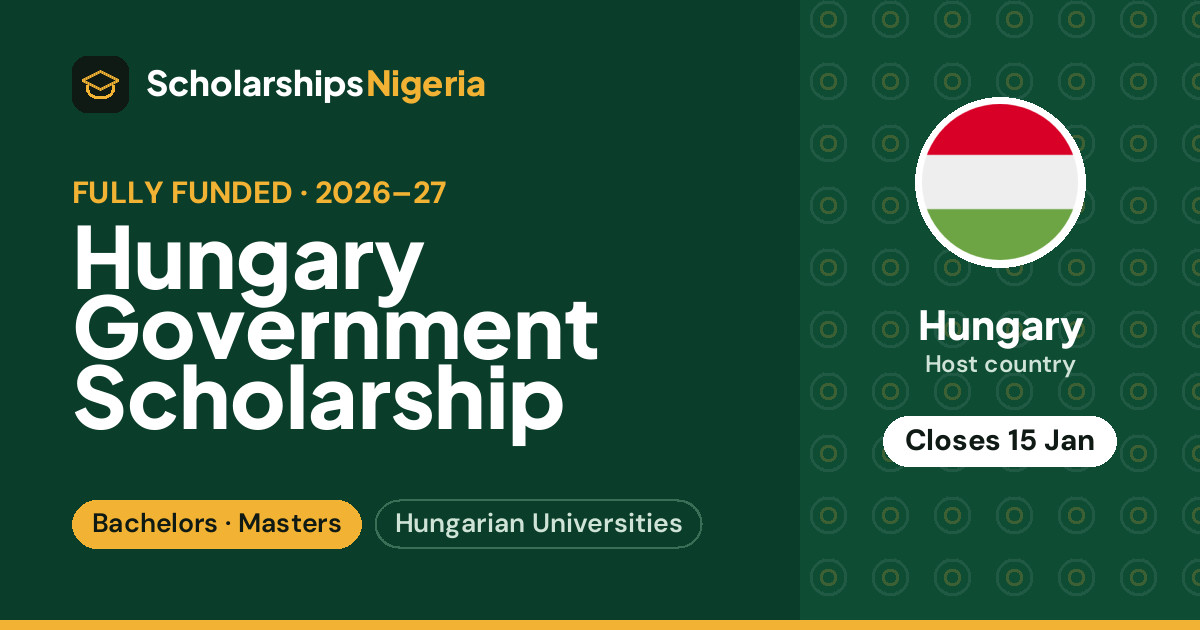
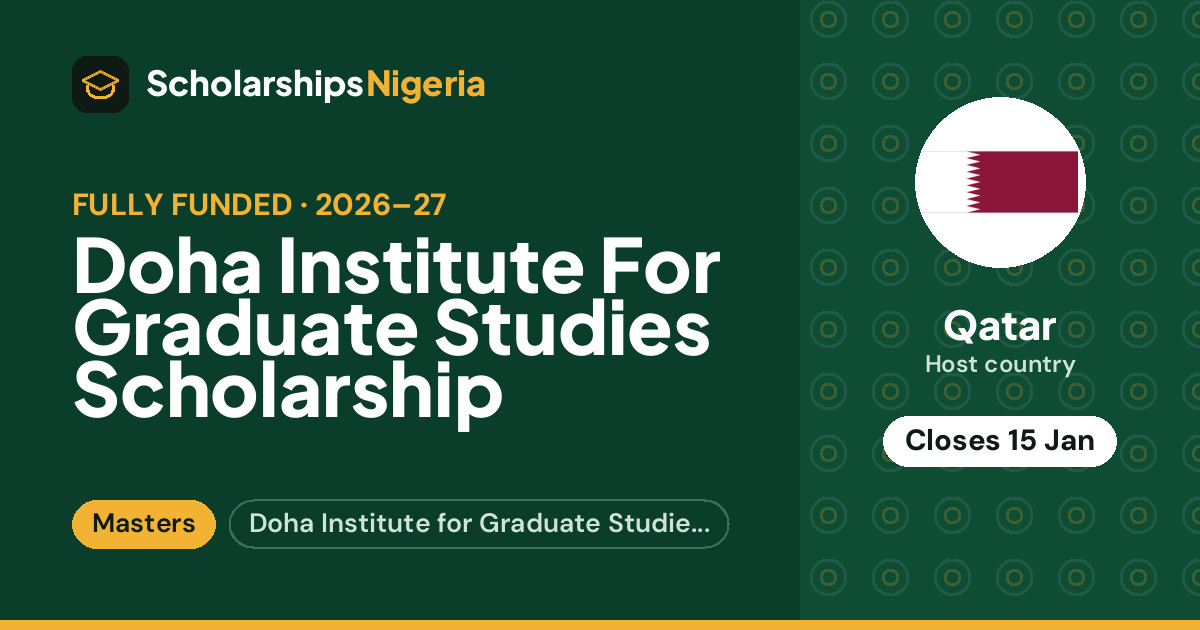
These five awards close soonest:
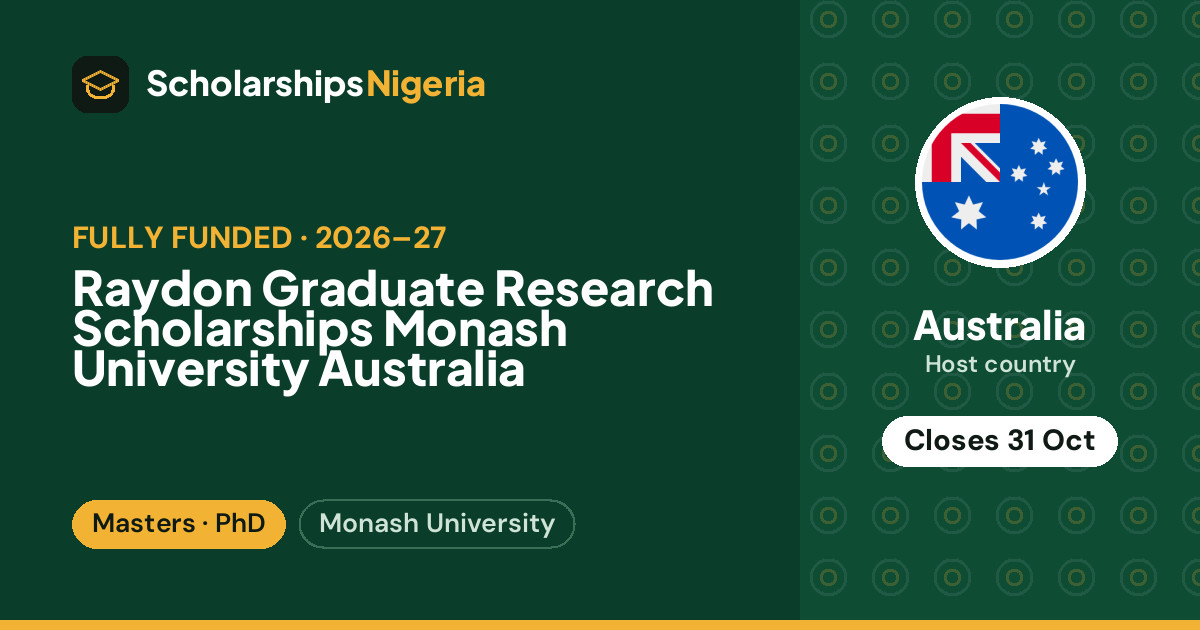
Also closing in October is Raydon Graduate Research Scholarships 2026-2027 Monash University Australia, at master's and PhD level, on 31 October. Where an award is undated, the provider's own page is the only reliable source, and you should check it before you commit to a courier.
How long the funding runs
Where an award states a duration, the most common is 2 years with 10 awards, followed by 3 years, 4 years and 1 year with 6 each. A 2-year award usually fits a taught master's, while 3 and 4 years fit doctoral study. If your programme is longer than the funded period, plan for the gap before you accept.
What to do next
Start with the awards closing soonest, because those deadlines are fixed and the documents take time. Order your transcripts now, not after you shortlist. Line up your referees and give them the award titles you are targeting. If an award asks for a research proposal, draft it before you approach a supervisor. Then work through the rest of the 184, filtering by level, country and field until you have a shortlist you can realistically complete.
For awards that do not state eligibility or a deadline, go to the provider's page and confirm both. That single step prevents most wasted application fees and courier costs.