What this page lists
This page collects 33 fully funded undergraduate scholarships open to Nigerian students. Every award here is for a first degree abroad, and every one of the 33 is labelled fully funded by the body offering it. That matters, because "scholarship" on other pages can mean a partial fee waiver. Here it does not.
The list is built for the point where you are now: you have finished secondary school, you hold WAEC, NECO, NABTEB or SSCE results, and you are looking for money to pay for a bachelor's degree outside Nigeria. Most of these awards ask for your senior secondary results and, in some cases, an admission offer. Each award page states its own entry requirement, and that is the page to read before you spend anything on a form.
Thirty of the 33 carry no nationality restriction at all. The remaining three name Nigeria or the region in their own text. There is no award on this page where eligibility is left unstated, so you can check your position on every single one.
Where the awards are
The spread is wide, and it is not only the usual destinations.
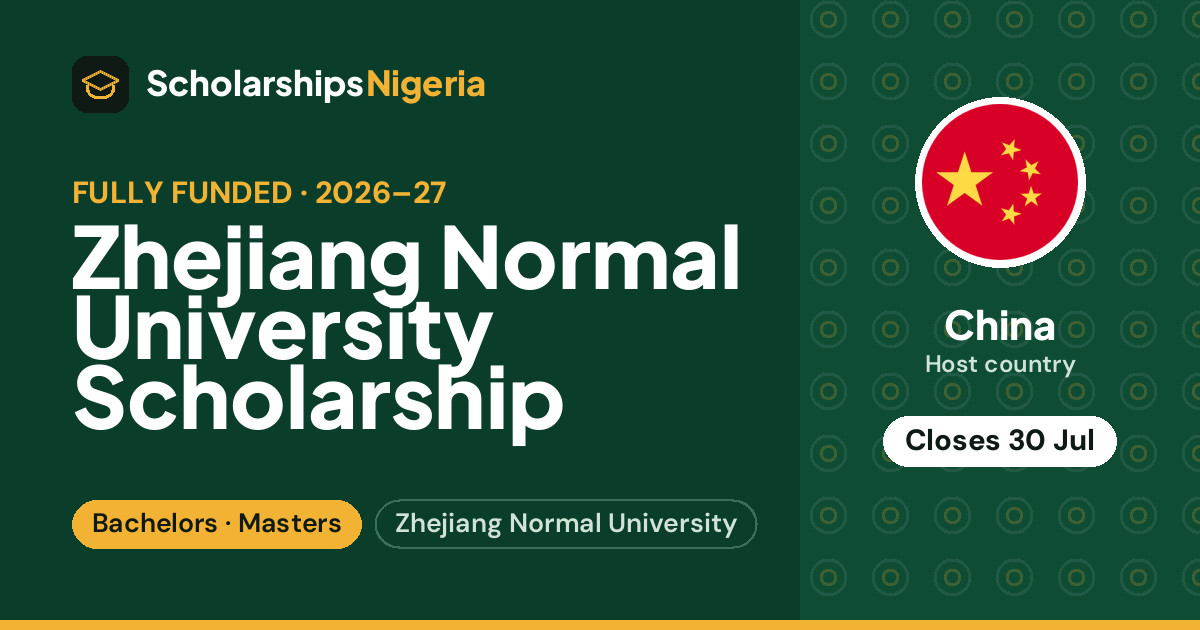
- China: 6
- Canada: 5
- United States: 5
- Australia: 2
- Germany: 2
- Italy: 2
- New Zealand: 2
- France: 1
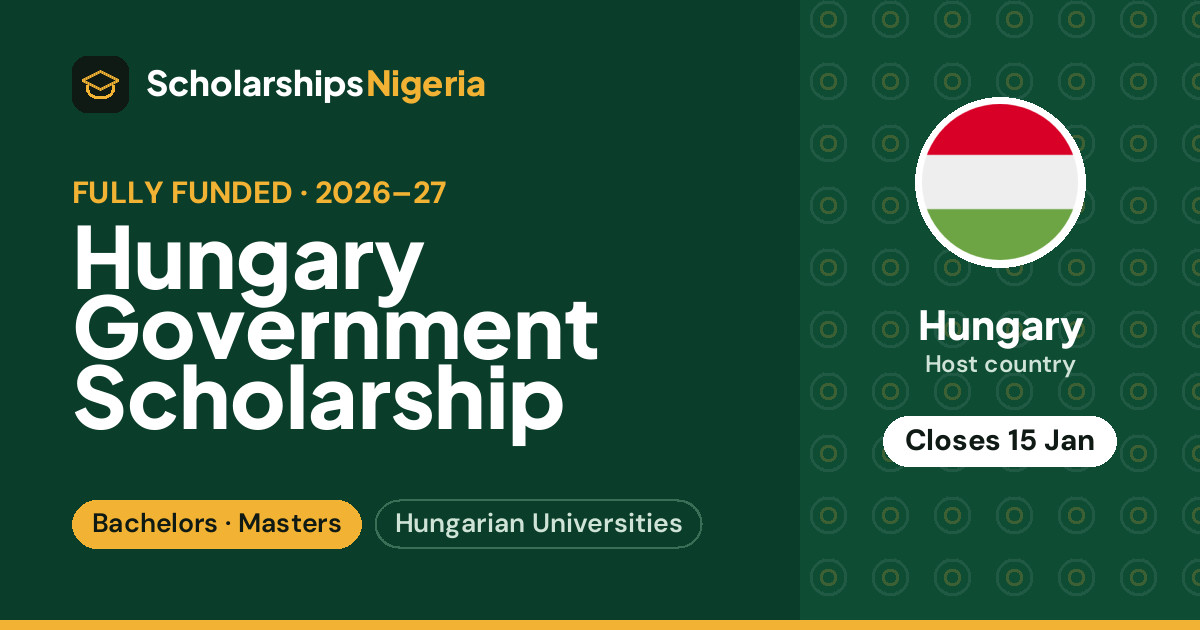
- Hungary: 1
- Japan: 1
- Saudi Arabia: 1
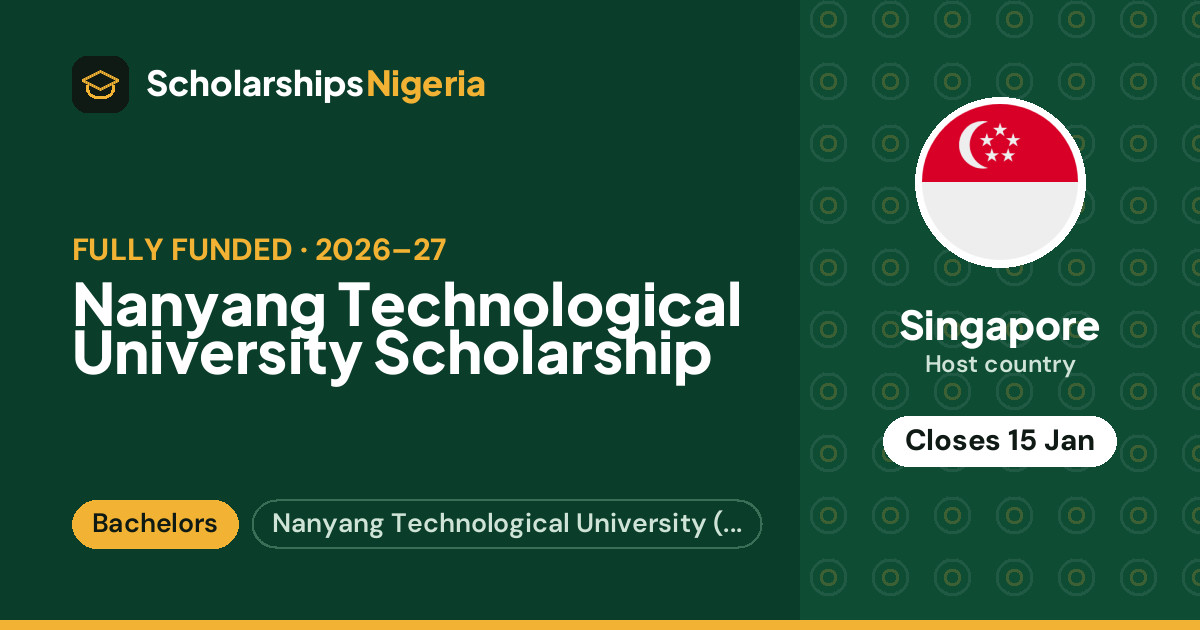
- Singapore: 1
- Spain: 1
- Turkey: 1
- United Arab Emirates: 1
- United Kingdom: 1
China leads with six, which reflects how many Chinese provincial and university schemes run separate undergraduate rounds. Canada and the United States follow with five each. Beyond that, the list is genuinely scattered: single awards in France, Hungary, Japan, Saudi Arabia, Singapore, Spain, Turkey, the United Arab Emirates and the United Kingdom. If you have been told that a fully funded first degree is only realistic in the United States or the United Kingdom, the country column on this page says otherwise.
What the awards say they cover
Fully funded is a broad term, so it is worth knowing what these particular awards put in writing. Of the 33, 18 name tuition, 11 name living costs, 10 name accommodation, 7 name health insurance, 5 name travel, and 2 name research or training costs.
Read those as what each award states in its own text, not as a promise that every item on the list appears in every award. Two awards mention research or training costs, which is unusual at undergraduate level and worth checking if your programme includes lab or field work. The award page is the only place where the exact package is set out, and it is the page you should be reading with a pen.
Two of the 33 give a figure for the number of awards on offer. The rest do not state how many places exist, so do not read a low number anywhere as a sign that the scheme is closed to you.
What the applications ask for
The demands are consistent enough to plan around. Across the 33 awards:
- 15 ask for letters of recommendation
- 8 ask for an English test score, IELTS or TOEFL
- 6 ask for a minimum degree class
- 4 ask for a research proposal
- 1 asks for an admission offer first
The recommendation letters are the item most Nigerian applicants underestimate. Fifteen awards want them, and a teacher or principal who has moved schools, retired or simply does not check email can cost you a deadline. Ask early, ask in person, and give the writer a stamped envelope or a clear email address to send to.
The English test is the second cost to plan for. Eight awards state it as a requirement. Where an award does not list it, the award page is the place to confirm whether a waiver applies to you, since some institutions accept a previous English-medium qualification instead. Do not assume a waiver exists; check the page.
The minimum degree class requirement appears on six awards. At undergraduate entry this usually refers to your secondary school grades rather than a university class, but read the wording on the award page carefully before you decide you qualify or do not.
Deadlines and how they fall
Seven awards on this page carry a stated date, and all seven are still open. The remaining 26 are undated, and seven of those run on a recurring cycle, which means the date moves each year and you should check the award page rather than rely on a date you saw last season.
The busiest months are January and May, with two deadlines each, and April with one.
The five closing soonest are:
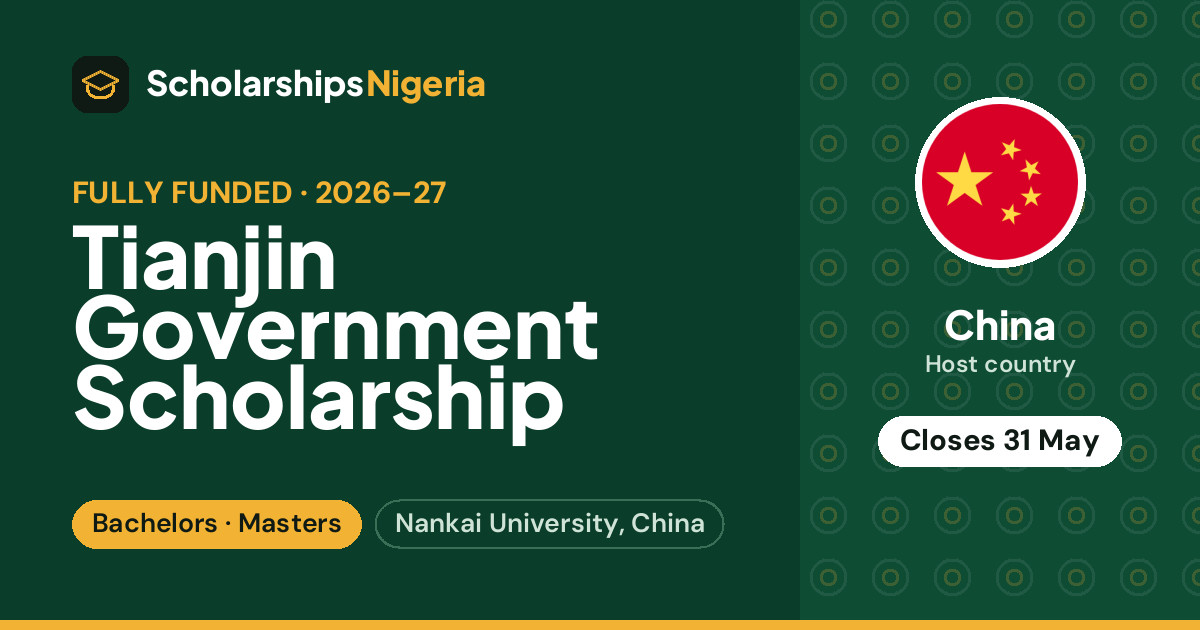
One further award, the Tianjin Government Scholarship 2026-2027, closes 31 May. That gives you a working calendar: one deadline in November, two in January, one in April, and two in May. Everything else needs to be tracked on its own page.
What the awards pay for, and for how long
Where a duration is stated, it reflects the length of the degree rather than the length of the funding promise. The figures given across the awards run from three to four years depending on the programme, four years, and four to five years at bachelor's level. One award sets out its structure as undergraduate four to five years, master's two to three years and PhD three to four years.
For a Nigerian applicant this is the number to hold on to. A four-year bachelor's degree funded in full is the commitment you are asking for, and it is the reason these schemes ask for so much paperwork up front.
Fields you can study
The awards are not confined to one faculty. Business and Management appears most often, with six awards, followed by Medicine and Health Sciences with five, and Arts and Humanities and Engineering with four each. Agriculture, Economics and Finance, Education and Law each appear three times. Computer Science and IT, Natural Sciences and Social Sciences appear once each.
If your subject sits in one of the smaller categories, the single listing is still a listing. Read it properly rather than skipping past it because the count is low.
Who provides them
The providers named on this page include Participating Australian Institutions, the University of Toronto, York University, Japanese Universities, McGill University and Clark University. Alongside these sit government schemes and individual universities in China, Hungary and elsewhere, which is why the country spread is as wide as it is.
Government schemes and university schemes behave differently. A government scholarship usually runs a single national competition with one set of forms. A university scholarship is often tied to admission, so your application to the university and your application for the money move together. Know which type you are dealing with before you start.
What to do next
Start with the deadline list above. The ACI Foundation award closes first, on 1 November, and the two January deadlines follow close behind. If you intend to apply to any of those three, your recommendation letters and any English test booking need to begin now, not in December.
Then work through the remaining awards by country. Open the award page for each one you are eligible for, read what it says it covers, and note what it asks for. Fifteen awards want recommendation letters, eight want an English test score, six state a minimum degree class, four want a research proposal and one wants an admission offer first. Those are the five things that decide whether your application is complete.
Finally, budget for the parts nobody funds. Transcripts, courier fees, test registration and certified copies come out of your own pocket, and they take longer than the forms do. Give them a fortnight of their own before any deadline, and you will not be the applicant who submits everything except the one document that mattered.