What this page lists
This page collects eight scholarships for Masters study in Economics & Finance that are open to Nigerian students. Every one of the eight is listed as fully funded. The awards sit in five countries: China accounts for four of them, while Australia, Japan, the Netherlands and Qatar carry one each.
Because the field is Economics & Finance, the awards are aimed at taught and research masters. Several of the providers on the list also fund PhD and undergraduate study, so you will see those levels mentioned in the award pages themselves. On this collection page, the eight entries are the masters-level Economics & Finance awards.
Who can apply
Six of the eight awards are open to Nigerian applicants. None of those six names Nigeria or the West African region in its eligibility text; they are open because they carry no nationality restriction at all. For the remaining two, the award page does not state eligibility either way, so you will need to read the full listing before you decide whether to spend money on a transcript or a courier.
That distinction matters when you are paying for documents out of pocket. An award with no nationality restriction is a straightforward yes on the question of whether you may apply. An award whose eligibility is not stated is a maybe, and a maybe is not worth a courier fee until you have read the terms.
What the awards pay for
All eight are labelled fully funded. Beyond that label, the individual award texts name specific benefits, and the counts below show how many of the eight mention each one in writing:
- Living costs: 4
- Tuition: 3
- Travel: 3
- Health insurance: 3
- Accommodation: 2
- Research or training costs: 1
Read those as what the awards say, not as a promise that every cost in your budget is covered. A fully funded award that names living costs and tuition but not travel still leaves you buying a ticket. Where an award names a stipend rate, the rate is stated on the award page and nowhere else — check it there, because rates are revised and indexed on the provider's own schedule.
Where the awards are, and what they are called
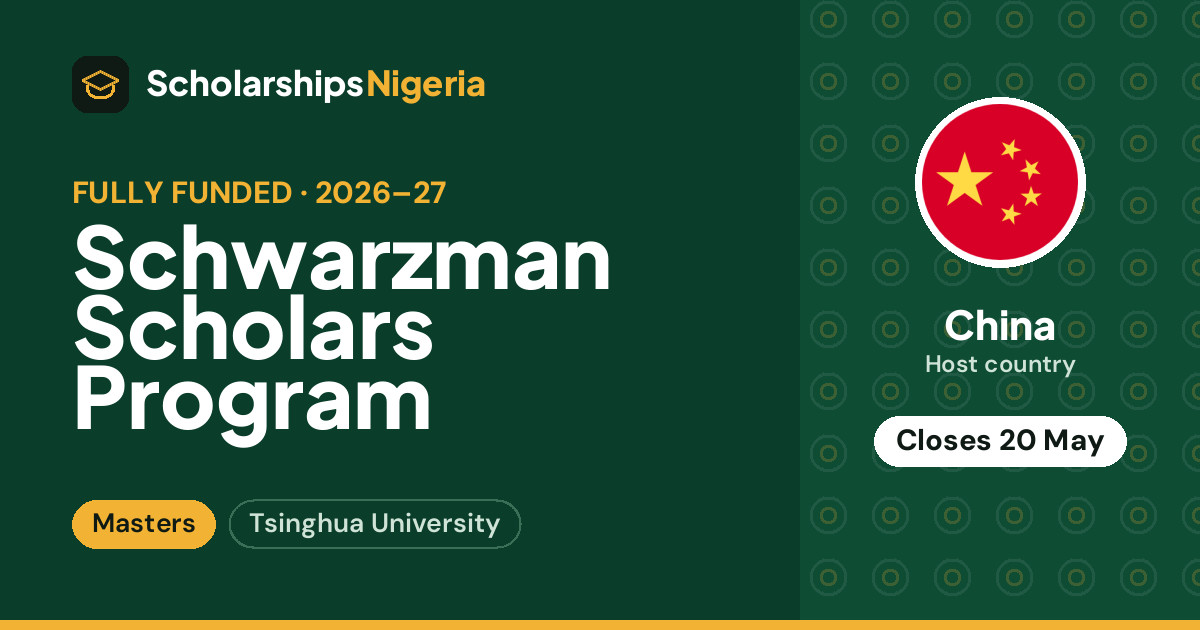
China is the largest single group with four awards, spread across Tsinghua University, Beijing universities and Shanghai universities. The other four sit in the Netherlands, Qatar, Australia and Japan.
The named awards closing soonest are:
Other awards on the page include the Shanghai Government Scholarship (SGS) Fully Funded 2026 - 2027 and the Beijing Government Scholarship 2026-2027 (Fully Funded). Both of those run across undergraduate, masters and PhD levels, so the masters route is one option among several on the same award.
What the applications ask for
The requirements stated on the award pages break down like this:
- Letters of recommendation: 4
- An English test score (IELTS or TOEFL): 3
- A minimum degree class: 2
- An admission offer first: 2
- A research proposal: 1
Two of the awards ask for an admission offer before you apply for the funding. That changes your order of work completely: you apply to the university first, wait for the offer, then submit the scholarship application. If you leave the admission stage late, the funding deadline will pass while you are still waiting.
Where an award states a minimum degree class, the wording is usually "upper second". On a Nigerian transcript that corresponds to Second Class Upper, written 2:1. Two of the awards on this page state a minimum class; the rest do not state one. Whether an HND is accepted in place of a degree is decided by each university, not by this page, so confirm it with the admissions office before you build your application around it.
Deadlines and how they fall
Four of the eight awards carry a stated date. Four are still open at the time of writing, four are undated on the award page, and four recur each year. The busiest months across the group are October, December and January, one award falling in each.
The dated awards close on 1 December, 15 January, 20 May and 1 October. The Shanghai Government Scholarship runs between January and June of each year rather than on a single date, and the Beijing Government Scholarship directs you to its details for the deadline.
The practical point is that the calendar is not evenly spread. If you are applying this cycle, the December and January deadlines are the ones that will arrive first, and they arrive during a period when Nigerian universities are also processing transcripts and your referees are busy. Start the paperwork before the deadline month, not inside it.
What a Nigerian application involves
The route into these awards is a first degree or an HND. The qualifications that lead in are B.Sc, B.A, B.Eng, LLB, MBBS and HND. The study level is masters, taught or research.
Three of the eight awards ask for an English test score, which means five do not state that requirement. Do not read that as a waiver. It means the award page does not mention it; the university's own admission rules may still require one, and some institutions waive the test where your previous degree was taught in English. Confirm the position with the university, not with this page.
Four awards ask for letters of recommendation. Approach your referees early, give them your CV and your statement, and be clear about the deadline. A referee who is asked in the same week the portal closes will often not deliver in time, and there is no appeal against a missing letter.
What to do next
Work backwards from the deadline. Identify whether your chosen award requires an admission offer first; if it does, the university application is your first task and the scholarship form is your second. If it does not, you can prepare both in parallel.
Then check the two awards whose eligibility is not stated on the page. Read the full listing before you order transcripts, because a transcript and a courier to a foreign university is money you do not get back if you turn out not to qualify.
Finally, note that the awards on this page sit in a wider set of listings by field and level. Economics & Finance overlaps with Business & Management, which appears on seven awards in the wider collection, and with Public Policy & Development and Social Sciences. If your intended masters sits between two fields, look at both sets of listings before you settle on a shortlist.