What this page lists
This page collects 5 PhD scholarships in the natural sciences that are open to Nigerian students. Every one of the five is a doctoral award, and every one of the five sits in the natural sciences. The awards are hosted in five different countries: Australia, Canada, Germany, the United Arab Emirates and the United States, one award each.
The list is short on purpose. Doctoral funding in the natural sciences is narrower than taught-masters funding, and a large share of it is tied to a specific research group or supervisor rather than to a general scholarship portal. What follows describes what these five awards say in their own text, so you can judge quickly whether any of them fits the research you want to do.
Who can apply
On nationality, nothing stands in your way. All 5 awards carry no nationality restriction in their eligibility wording. None of the five names Nigeria or the West African region specifically, which means you are applying through the general international route rather than a country-specific quota.
On qualifications, the entry point is a master's degree. The pathway into this level assumes you already hold one of an M.Sc, M.A, MBA or M.Phil. If your highest qualification is a B.Sc or HND, these particular awards are not the right starting point; you would be looking at masters-level funding first.
One award states a minimum degree class as part of its requirements. That is a single award out of the five, so read the individual pages rather than assuming a blanket class requirement across the list.
What the awards pay for
Funding labels are not uniform across the five. 3 of the 5 are labelled fully funded, and 1 is labelled partially funded. The remaining award does not label its funding either way, so nothing can be said about what it covers.
Where the award text names a specific benefit, the counts are small and worth reading literally:
- 1 award names tuition in its own text
- 1 award names health insurance in its own text
Those are what the awards state in writing, not a guarantee of what lands in your account. Stipends, travel, relocation and bench costs vary by award and by host institution, and several of these pages will direct you to the university's own doctoral funding rules for the rest.
What the applications demand
The paperwork is where most Nigerian applicants lose time, so it is worth knowing the shape of it before you shortlist anything.
- 3 awards ask for an English test score (IELTS or TOEFL)
- 3 awards ask for a research proposal
- 2 awards ask for letters of recommendation
- 1 award asks for a minimum degree class
The research proposal is the item to start on first. Three of the five want one, and a proposal cannot be written quickly: it needs a defined question, a method, and a reason the host group is the right place to do the work. If you are also chasing an English test, book the test date early. Seats fill, results take time to reach the awarding body, and a missing score can sink an otherwise strong file.
Letters of recommendation are the other bottleneck. Two awards ask for them. Approach your M.Sc supervisor and one other academic who knows your laboratory or fieldwork, and give them your draft proposal and your CV rather than a vague request.
Where the awards are
The five awards are spread one per country:
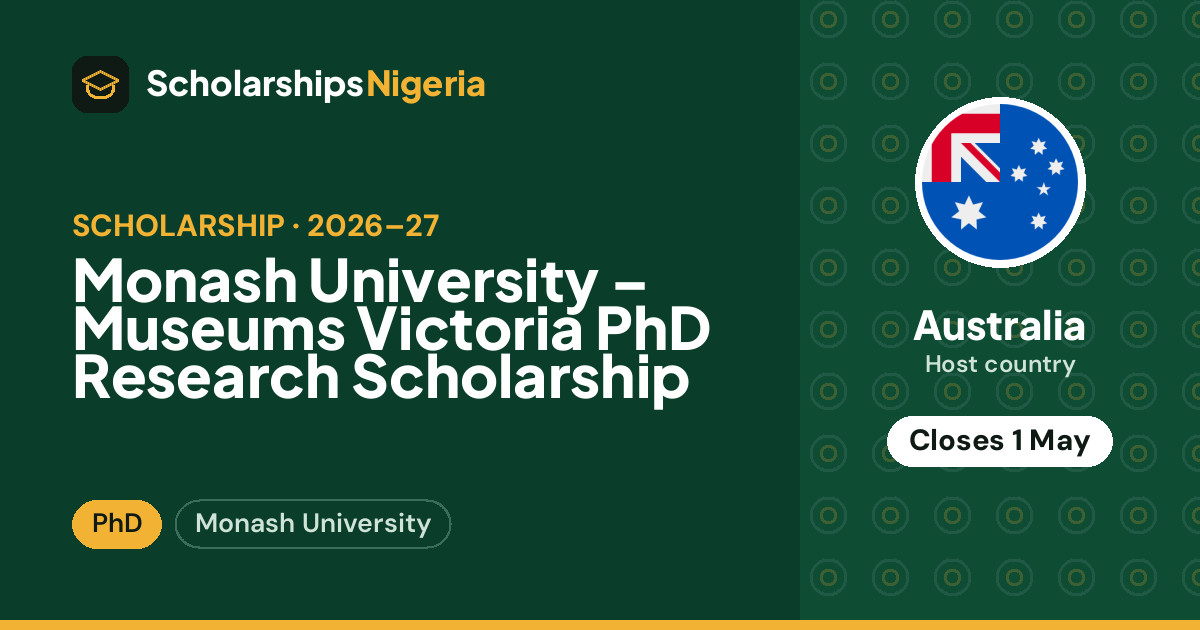
- Australia — Monash University
- Canada — a Canadian institution with a quota to host Vanier scholars
- Germany — International Max Planck Research School
- United Arab Emirates — Muhammad Bin Zaid University
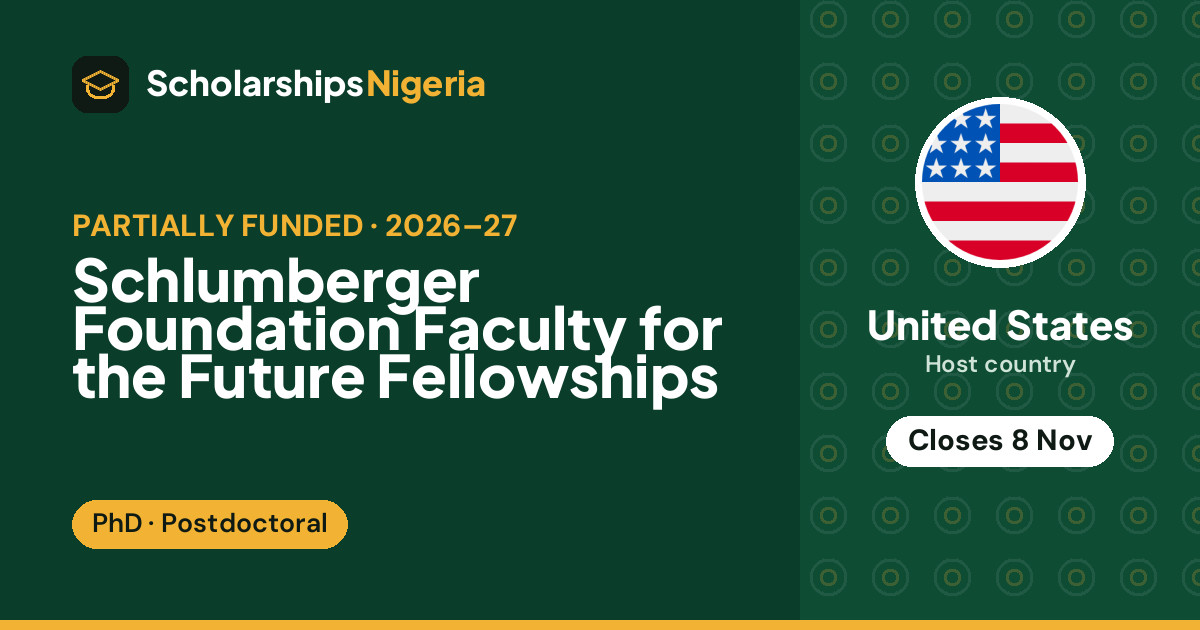
- United States — Schlumberger Foundation Faculty for the Future Fellowships
That spread matters practically. A German doctoral place and a Canadian doctoral place are funded and administered differently, and the same is true of the Australian and UAE awards. Read each page for how the money is routed and who you deal with.
The deadlines, and how they fall
Two of the five carry a stated date. Two are recorded as still open. Three are undated in the listing, and two are recurring, meaning the cycle returns rather than closing permanently.
The busiest months across this set are May and November, one award each. The two closing soonest are named below.
The Monash award states 2 awards per year. The remaining three on the list are:
Note the shape of that. One award takes applications at any time, which means the deadline is effectively yours to set. The others run on fixed cycles, and the Canadian one is anticipated rather than confirmed, so treat its date as a planning marker and confirm it on the page before you build a calendar around it.
What the study itself involves
Doctoral awards in the natural sciences are usually attached to a supervisor or a research group. That single fact changes how you apply. The programme application and the scholarship application often share one deadline, and the supervisor has to want you before the funding question is settled.
Where a duration is stated, the awards run for 3 years, 4 years, or 3–4 years full-time. Plan your funding around the shorter figure and treat any extension as something to negotiate with the department, not something to assume.
This is also why the research proposal carries so much weight here. Three of the five ask for one. It is the document that tells a group leader whether your interests overlap with work they are already funded to do.
What to do next
Start with the two awards that close soonest, because a fixed date forces a decision. Read the Schlumberger Foundation page and the Monash page in full, and check whether the research area matches anything you have already done at M.Sc level.
Then work backwards from the deadline. A research proposal takes weeks, not days. An English test takes booking and waiting. Recommendation letters take a supervisor's attention, which is not always available on demand. If you are paying for transcripts and courier fees out of pocket, order those documents once you have a shortlist of two or three awards rather than for all five at once.
For the awards without a fixed date, particularly the Max Planck listing, the constraint is fit rather than time. Identify the research group first, then approach it. For the Canadian and UAE awards, confirm the current cycle dates on the page before you commit to a timeline.
Five awards is a small list, and that is realistic for this level. Work each one properly rather than spreading a thin application across all of them.