What this page lists
This collection brings together 19 engineering scholarships open to study at universities outside Nigeria. Every award on the page is tagged to the field of Engineering, and the list is drawn from providers in eleven countries: Australia, China, the United States, the United Kingdom, Canada, the Netherlands, Romania, Singapore, Sweden, Switzerland and the United Arab Emirates.
The awards are not all the same shape. 13 are labelled fully funded and 4 are labelled partially funded. Two do not state their funding position either way, so treat those as unknown until you read the award page itself. What follows is a breakdown of who can apply, what the awards say they pay for, what they ask you to submit, and how the deadlines fall.
Who the awards are open to
Of the 19 awards, 15 state that Nigerians may apply. Within that group, 2 name Nigeria or the region directly in their eligibility text, and 13 carry no nationality restriction at all. The remaining 4 do not state their eligibility on the award page, which means you will need to check the provider's own terms before you spend money on a transcript or a courier.
That distinction matters when you are paying for documents out of pocket. An award with no nationality restriction is the safer bet to prepare for, because nothing in its own text rules a Nigerian applicant out. An award that names Nigeria or the region has already told you it wants applicants from here. Where eligibility is unstated, do the reading first and the spending second.
Which study levels are covered
The list spans several levels, and some awards count at more than one, so the numbers below add up to more than 19.
- Masters: 13 awards
- PhD: 13 awards
- Bachelors: 7 awards
- Fellowship: 2 awards
- Postdoctoral: 1 award
- High School: 1 award
For a Nigerian reader, the Masters and PhD counts are where most of the opportunity sits. If you hold a B.Sc or HND and are weighing a taught Masters abroad, or you hold an M.Sc and are looking at doctoral funding, the bulk of this page speaks to you. The Bachelors awards matter if you are applying from secondary school or shortly after, and the single High School entry is worth a look if you are planning early.
Where the awards are
Australia leads with 4 awards, followed by China with 3 and the United States with 3. The United Kingdom has 2. Canada, the Netherlands, Romania, Singapore, Sweden, Switzerland and the United Arab Emirates each have 1.
Australia's position at the top of the list is worth noting if you are comparing English-speaking destinations. Monash University alone appears twice among the providers, and the University of Tasmania also appears. Stanford University, Boston University and the University of Groningen are named among the examples on the page. Shanghai universities appear as a group, and one award is hosted by a Canadian institution with a quota to host Vanier scholars.
What the awards say they cover
These figures count how many awards name each benefit in their own written text. They are not a promise that every award pays all of this.
- Tuition: named by 6 awards
- Living costs: named by 5 awards
- Travel: named by 3 awards
- Accommodation: named by 3 awards
- Research or training costs: named by 3 awards
- Health insurance: named by 1 award
- A settling-in or arrival grant: named by 1 award
Read that list carefully before you budget. A fully funded label tells you the award is comprehensive by its own description, but the specific line items above show what is actually written down. Tuition and living costs appear most often. Travel, accommodation and research costs appear less often. Health insurance and an arrival grant appear once each. If an award you are considering does not name travel, plan for your own flight.
What the applications ask for
Again, these are counts of awards that state the requirement in their own text.
- Letters of recommendation: 8 awards
- An English test score (IELTS or TOEFL): 7 awards
- A research proposal: 5 awards
- A minimum degree class: 3 awards
- An admission offer first: 2 awards
- Work experience: 1 award
Two things stand out for a Nigerian applicant. First, recommendation letters are the single most requested item, so line up your referees early and give them something written to work from. Second, seven awards name an English test score, which means you should confirm whether the specific award requires IELTS or TOEFL before you pay for a test date. Some awards do not name a test at all, so check each one rather than assuming.
Five awards ask for a research proposal. That points to the research-heavy end of this list, mainly at Masters and PhD level, where you will need to describe a project rather than simply present your grades. Three awards name a minimum degree class, so have your transcript and your class of degree wording ready. Two awards require an admission offer before you can apply for the funding, which changes the order of your tasks entirely: you must win a place at the university first. One award names work experience.
How the deadlines fall
11 awards carry a stated date and 11 are recurring, meaning the cycle returns. 8 are undated. The busiest months are October with 3 deadlines, December with 2 and April with 1.
The awards closing soonest are listed below, with their internal pages.
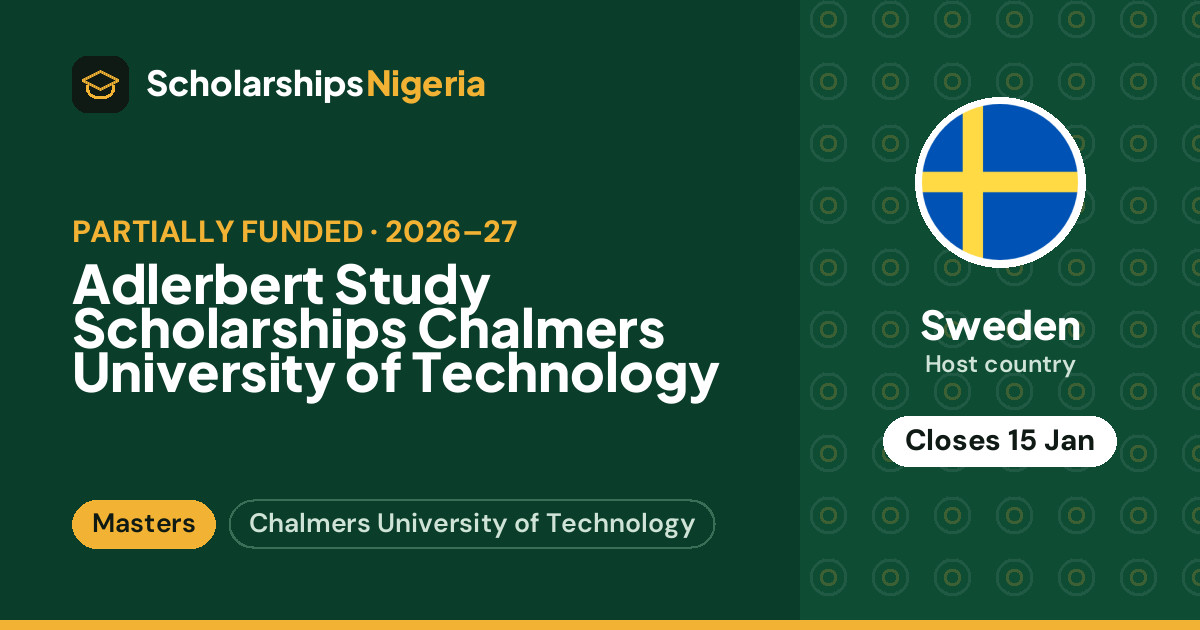
One further example on the page, the Adlerbert Study Scholarships 2026-2027 at Chalmers University of Technology in Sweden, closes 15 January. Where durations are stated, they include four years and three years, and one PhD entry notes three and a half years with no extension available, which is worth reading in full before you commit.
What to do next
Start with eligibility. Open the award page and confirm whether Nigerians may apply, because 4 of the 19 do not state it. Then check the level against your own qualification: a B.Sc or HND points you towards the Masters entries, an M.Sc towards the PhD and postdoctoral entries, and secondary school results towards the Bachelors and High School entries.
Next, work backwards from the deadline. If an award requires an admission offer first, your university application comes before the funding application, and that gap can be months. If it requires a research proposal, draft it early and have a supervisor or lecturer read it. If it requires IELTS or TOEFL, book the test with enough room for the result to reach the provider.
Finally, be deliberate about what you spend. Transcripts and courier fees are real money. Confirm eligibility and the document list before you order anything, and prioritise the awards whose own text already tells you that a Nigerian applicant is welcome.