What is on this page
This page lists 10 fully funded scholarships in Canada open to Nigerian students. Every award here is labelled fully funded by the body offering it, and every one is in Canada. The list is not a single programme with ten names attached; it is ten separate awards from ten separate providers, each with its own application form, its own referees and its own closing date.
Six of those providers are named in the listings: the University of Toronto, the University of British Columbia, York University, McGill University, the University of Waterloo, and one Canadian institution holding a quota to host Vanier scholars. The rest sit with other Canadian institutions. Because the awards are spread across different universities, you cannot treat this as one application. You will be applying to institutions, not to a country.
Which levels the awards are for
The list leans towards two ends of the academic ladder. Seven awards are open at Bachelors level and five at PhD level, with four at Masters level and two listed as fellowships. Some awards appear under more than one level because they cover a combined Master’s and doctoral route, which is why the level counts add up to more than ten.
For a Nigerian reader this matters in a practical way. If you have just finished WAEC or NECO and are looking at undergraduate study abroad, the Bachelors group is the one to work through first. If you are finishing an M.Sc and want a funded doctorate, the PhD and fellowship entries are where your research proposal and supervisor conversations will sit.
Who can apply
Of the ten awards, seven are open to Nigerian applicants. Within that group of seven, none names Nigeria or the West African region as a condition, and all seven carry no nationality restriction at all. In other words, the route for a Nigerian applicant is not a special Nigerian quota; it is an award that simply does not screen by passport.
Three of the ten do not state their eligibility on the award page. That is not the same as saying you are excluded. It means the listing does not spell out who may apply, so you would need to read the provider’s own terms before you spend money on transcripts or a courier.
Canada is a realistic destination for Nigerian students, not a speculative one. The UNESCO Institute for Statistics recorded 12,072 Nigerian students in Canada in 2023, making Nigeria the third largest source of international students there. You would be joining an established group, not arriving alone.
What the awards say they cover
Funding is described differently from one award to the next, and the safest approach is to read what each one states in writing rather than assume a standard package.
- Three awards name tuition in their own text.
- One names living costs.
- One names travel.
- One names accommodation.
That is a small set of explicit statements across ten awards. Many listings describe themselves as fully funded without breaking the package into these lines, and this page does not invent detail that the award itself does not give. Where an award does not name a benefit, treat it as unconfirmed until you have the provider’s own funding letter or handbook in front of you.
None of the awards on this list states a cash value in the listing, and none states a number of awards available. Do not build a budget around a figure you have not seen in writing from the university.
What the applications demand
The most common requirement by a distance is referees. Five awards ask for letters of recommendation. If you are applying to several of these at once, line up your referees early and give them the same information pack each time: your CV, your transcript, your statement, and the exact deadline. Nigerian referees are usually willing but slow, and a late letter sinks an otherwise strong file.
Beyond that, the requirements thin out quickly:
- One award asks for an English test score such as IELTS or TOEFL.
- One asks for a minimum degree class.
- One asks for a research proposal.
The English test point deserves attention. Only one award states the requirement in its listing, but that does not mean the others waive it, because most do not state their requirements at all on the award page. Where a test is required, a degree taught in English is sometimes accepted in place of a score, but that decision belongs to the university, not to this page. Ask the admissions office directly before you pay for a test.
The research proposal requirement sits with the doctoral awards. If you are targeting a PhD, start drafting before you start applying, and start talking to a potential supervisor before that.
How the deadlines fall
Deadlines are the weakest part of the picture, and you should plan around that rather than wait for a tidy calendar.
One award has a stated date. One is still open. Nine are undated in the listing. One is described as recurring. February is the busiest month, with one award closing then.
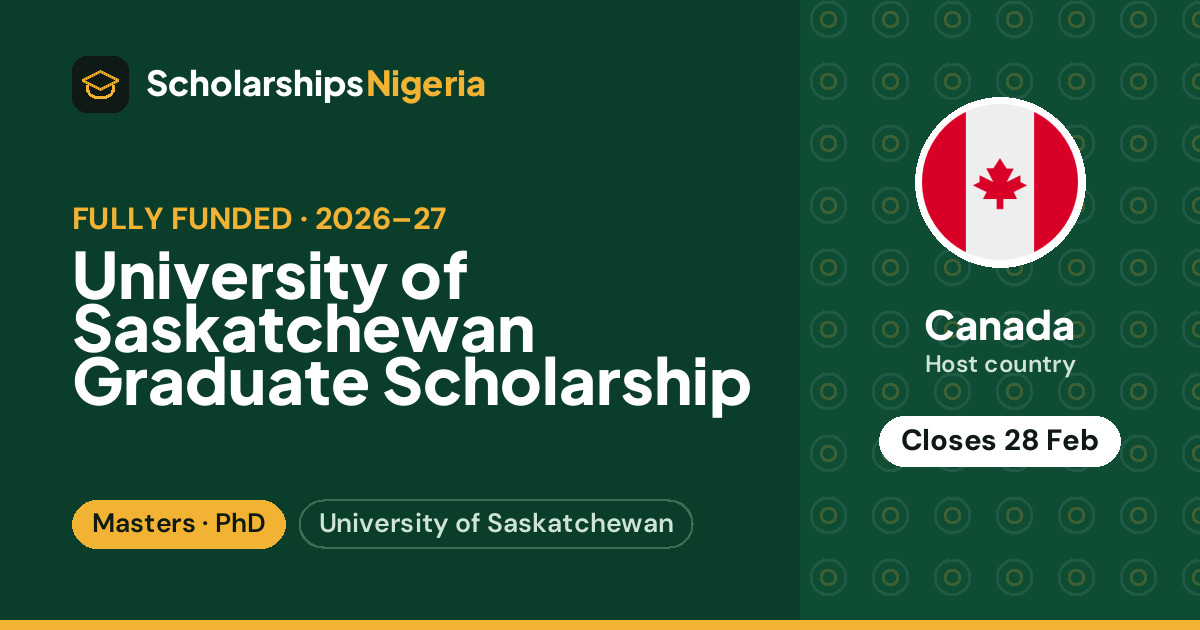
The award closing soonest is the University of Saskatchewan Graduate Scholarship 2026-2027, which closes 28 February, with 143 days left from the date this page was compiled. It is open at Master’s and doctoral level.
Two other dates are worth noting. The Vanier Canada Graduate Scholarship (Vanier CGS) 2027 is listed as closing before November 2026, anticipated for the 2026-2027 competition, and it is a doctoral award. The York University Scholarships 2027 give a Fall 2026 admission deadline of 15 February 2026. That is an admission deadline rather than a scholarship deadline, and the two are not the same thing, so read the award page carefully.
Several listings simply say "see details" or "admission deadlines". For those, the deadline is tied to the university’s admission cycle, which means your real deadline is earlier than the one printed on the scholarship page. Admission first, funding second.
How long the funding runs
Where a duration is stated, it is tied to the programme rather than to a fixed national rule. The listings give three years, four years, three to four years depending on the selected programme, and four years for a PhD with three years for a Master’s. Each of those appears once.
This is the detail Nigerian applicants most often overlook. A four-year doctoral award assumes you finish in four years. If your research runs long, the funding does not automatically follow, and you would be covering the extra period yourself. Ask each provider what happens in year five before you accept an offer.
Where to start
Work through the list in this order. First, decide your level, because the Bachelors and PhD groups barely overlap in what they ask of you. Second, take the awards that name Nigeria-friendly terms and no nationality restriction, and read each one’s own page in full, since three of the ten do not state eligibility at all. Third, fix your referees, because five awards want letters and that is the requirement most likely to delay you.
Then handle documents. Transcripts from a Nigerian university take time, and courier costs are yours. Order them once you have a shortlist, not once you have an offer, because the February deadlines will not wait for a transcript to travel.
Start with the award that has a date you can plan around: the University of Saskatchewan Graduate Scholarship 2026-2027. Then read the Vanier Canada Graduate Scholarship if you are doctoral-bound, and the Lester B. Pearson International Scholarship Program at the University of Toronto if you are applying as an undergraduate. The UBC Four Years Doctoral Fellowship, the York University Scholarships and the McGill University Scholarships and Fellowships complete the named entries on this page.
Ten awards, ten sets of rules. Read each one before you commit money to any of them.