What this page lists
This page collects 6 undergraduate scholarships in China that are open to Nigerian students. Every one of the six is labelled Fully Funded by the award itself. They are offered by Chinese universities and provincial governments, and they cover a first degree rather than a master's or a doctorate.
If you have finished secondary school and you are looking for funding for a bachelor's degree in China, these are the awards currently indexed here. Each one also appears on our wider China listings, which is why the same names turn up under master's and PhD filters as well.
Who is offering them
The six awards come from six different providers, so you are not looking at one scheme repeated. They are:
- Shanghai Universities (check list below)
- Beijing Universities
- Yangzhou University
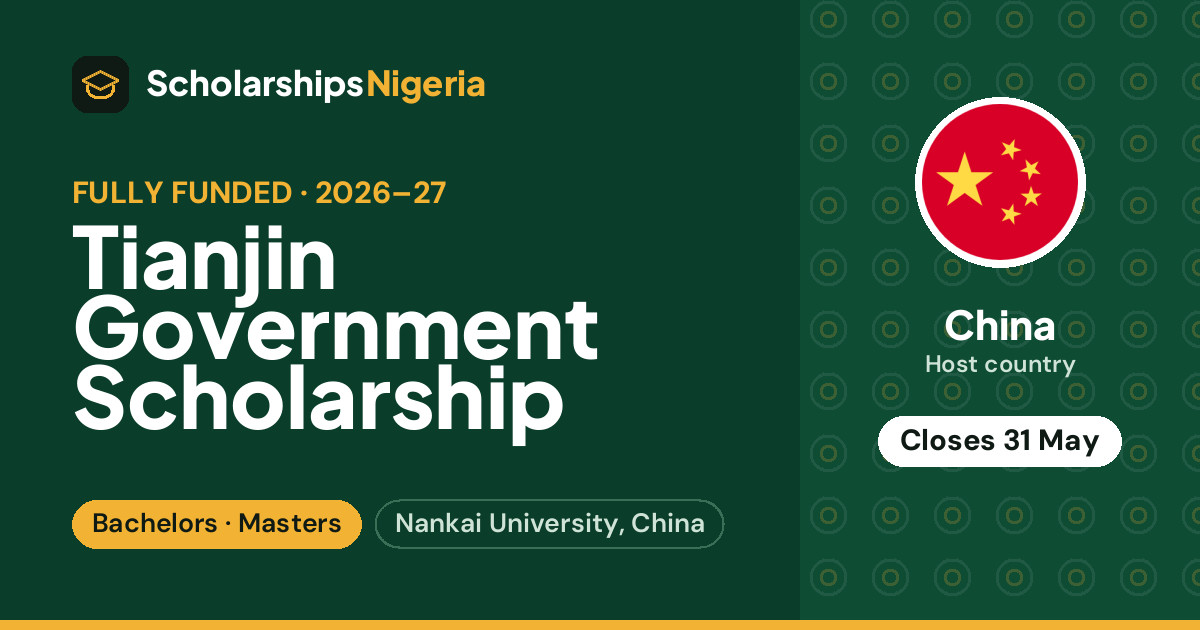
- Nankai University, China
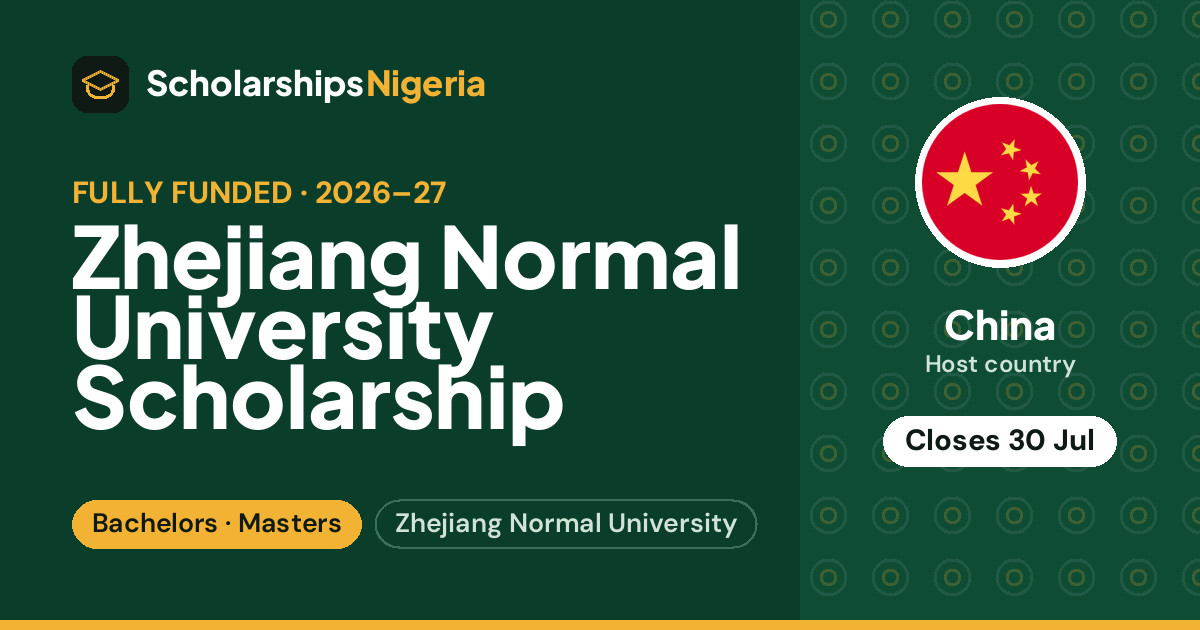
- Zhejiang Normal University
- Hubei Government
Two of these are city or provincial government schemes rather than a single university's own scholarship, which matters when you apply. A government scholarship is usually administered through a list of participating universities, so your choice of institution and your choice of scholarship are linked. Read the individual award page before you decide where to send your application.
Does being Nigerian disqualify you?
No. All 6 of the awards on this page carry no nationality restriction. None of them names Nigeria or a specific region as a condition, and none of them leaves the eligibility question unstated. In plain terms, the award text does not shut Nigerian applicants out.
That is not the same as saying you will be selected. It means the nationality box is not the obstacle. What decides your case is your secondary school results, the documents you submit, and whether you meet the entry requirement quoted on the award page you are applying to.
What the awards say they cover
Because all six are labelled fully funded, the expectation is that tuition and the main costs of study are met. The award texts themselves name specific benefits in these numbers:
- Tuition — named by 3 awards
- Accommodation — named by 3 awards
- Living costs — named by 2 awards
- Health insurance — named by 2 awards
- Research or training costs — named by 1 award
Treat those counts as what is written down, not as a promise. Where an award does not list a benefit in its own text, do not assume it is included, and do not assume it is excluded either. Open the award page and read the funding section yourself before you build a budget around it.
Which subjects you can study
The six awards between them name eight broad fields. Each field is named by 3 of the awards:
- Agriculture
- Arts & Humanities
- Business & Management
- Economics & Finance
- Education
- Engineering
- Law
- Medicine & Health Sciences
These are broad labels, not a course list. A field being named by an award does not mean every department at that university accepts undergraduate scholarship holders. Check the specific programme before you commit to a choice, particularly for Medicine & Health Sciences and Engineering, where intake is often tighter than the general field listing suggests.
What the applications ask for
Across the six awards, the stated requirements break down like this:
- Letters of recommendation — asked for by 4 awards
- An English test score (IELTS or TOEFL) — asked for by 2 awards
- A research proposal — asked for by 2 awards
- An admission offer first — asked for by 1 award
Two things are worth noting for a Nigerian applicant. First, only two of the six state an English test requirement in writing, so a waiver may be possible on the others — but a waiver is granted by the university, not by this page, so ask before you pay for a test. Second, a research proposal is normally a postgraduate document. Where an undergraduate award asks for one, read the page carefully to see what it actually wants from a first-degree applicant.
Recommendation letters are the most common ask. Line up your referees early, because your former teachers and lecturers will need time, and some will want to see the award details before they write.
Deadlines and how they fall
Of the six awards, 3 carry a stated date, 3 are recurring, and 3 are still open. The busiest months are May, with two deadlines, and July, with one.
The three closing soonest are:
The remaining three are the Shanghai Government Scholarship (SGS) Fully Funded 2026 - 2027, which runs between January and June of each year; the Beijing Government Scholarship 2026-2027 (Fully Funded); and the Hubei Government Scholarship 2026 (Fully Funded). The last two do not publish a date on the listing, so you will need to open them and read the details.
Undergraduate programmes in China generally run for four to five years. One award on this page describes a bachelor's degree programme of 4 to 5 years, and another describes a bachelor's programme of 4 to 6 years. Plan for the longer figure when you are thinking about how long you would be away.
What you need before you start
These awards lead in from secondary school. The qualifications in play are WAEC, NECO, NABTEB or SSCE, and the level is a first degree. Most awards at this level ask for your senior secondary results, and one of the six asks for an admission offer first.
That last point shapes your order of work. Where an admission offer is required before the scholarship application, you must apply to the university first and wait for a decision, which adds weeks you cannot recover later. Start there if the award you want is the one with that condition.
For the rest, the practical sequence is: gather your secondary school results and your certificate, request transcripts and any supporting documents from your school, brief your referees, and only then begin the online forms. Courier and transcript costs are yours to carry, so build them into your plan rather than discovering them at the deadline.
Where to go next
Open the three awards closing in May and July first, since those dates are fixed and the others are not. Read the funding section on each page to see what is actually named, then read the eligibility section to confirm the entry requirement for your own results.
If your interest is a master's or a doctorate rather than a first degree, the same six providers also appear under those levels, and you can move to those listings from here. If you are set on an undergraduate degree in China, work through all six pages before you decide. Applying to one and ignoring the rest narrows your chances for no good reason.