What this page lists
This page collects 8 undergraduate scholarships in China that are open to international applicants, including Nigerian students. Every one of the eight is labelled fully funded by the award itself. That is the whole list: eight awards, one country, one study level.
They are not all the same kind of award. Some are university scholarships run by a single institution. Some are city or provincial government schemes that a group of universities takes part in. The providers named on this page include Shandong University, Yangzhou University, Central South University, Nankai University, a set of Beijing universities, and a set of Shanghai universities. The names matter less than the structure: each award has its own application route, its own documents and its own closing date, even when two of them close on the same day.
Who can apply
Of the eight awards, 6 are open to Nigerian applicants. None of those six names Nigeria or the African region in its eligibility text; they are open because they carry no nationality restriction at all. That is a useful distinction. It means your nationality is not the hurdle — your documents and your qualifications are.
The remaining 2 awards do not state their eligibility on the award page. Treat those as unknown until you open them and read the entry requirements yourself. Do not assume you qualify, and do not assume you do not.
This is a first-degree list. The Shandong University Scholarship and several others run across undergraduate, master’s and PhD levels, so a Nigerian applicant with WAEC, NECO, NABTEB or SSCE results is applying into the undergraduate track of a scheme that also serves postgraduate students. You are not competing only against school leavers.
What the awards pay for
Because all eight are marked fully funded, the question is what each one says in writing that it covers. The counts below are how many of the eight name that benefit in their own text.
- Tuition — named by 4 awards
- Accommodation — named by 4 awards
- Living costs — named by 3 awards
- Health insurance — named by 3 awards
- Research or training costs — named by 1 award
Read that list carefully before you plan anything. “Fully funded” on a listing page is a label; the award page is where the actual package sits. A scheme that covers tuition and accommodation but says nothing about a monthly stipend leaves you feeding yourself, and in China that is a real monthly cost you will carry from Nigeria unless the award states otherwise. Where an award does not name a benefit, do not fill the gap yourself.
What the applications demand
The requirements below are counted from what the awards state. They are the documents you will be chasing, and most of them cost you money or time before you ever submit.
- Letters of recommendation — required by 5 awards
- An English test score (IELTS or TOEFL) — required by 4 awards
- An admission offer first — required by 3 awards
- A research proposal — required by 2 awards
The admission-offer-first group is the one that catches Nigerian applicants out. Three of these awards will not look at your scholarship application until a Chinese university has already offered you a place. That means two separate application processes, run in sequence, with the university admission coming first. If you leave the admission application until the scholarship deadline week, you have already missed it.
The English test requirement is worth checking award by award rather than assuming. Four of the eight state it. The other four do not state it, which is not the same as waiving it — it means the award page does not say. If you studied your secondary school and any degree in English, ask the admissions office directly whether they will accept a medium-of-instruction letter instead of IELTS. Some will, some will not, and only the university can tell you.
Two awards ask for a research proposal at undergraduate level. That is unusual, and it tells you those schemes are structured around a supervised project rather than straight coursework. If you are applying from a Nigerian secondary school background with no research experience, that is a real piece of writing to prepare, not a paragraph you dash off.
How long the programmes run
The award pages quote different programme lengths, and they do not agree with each other. One states a bachelor’s degree programme of 4 to 5 years. Another states a bachelor’s of 4–5 years, a master’s of 3 years and a doctorate of 4 years. A third states a bachelor’s of 4–6 years, a master’s of 2–3 years and a doctorate of 3 years.
Plan for the longer figure. A Chinese bachelor’s degree taught in Mandarin commonly runs longer than the four years a Nigerian university would take, because the first year is often language study. If you are applying into an English-taught programme, confirm the duration on the specific award page rather than assuming the shorter number applies to you.
Deadlines
Five of the eight awards give a dated deadline. Five are still open. Three carry no date at all, and five are recurring — they come round again on the same cycle each year.
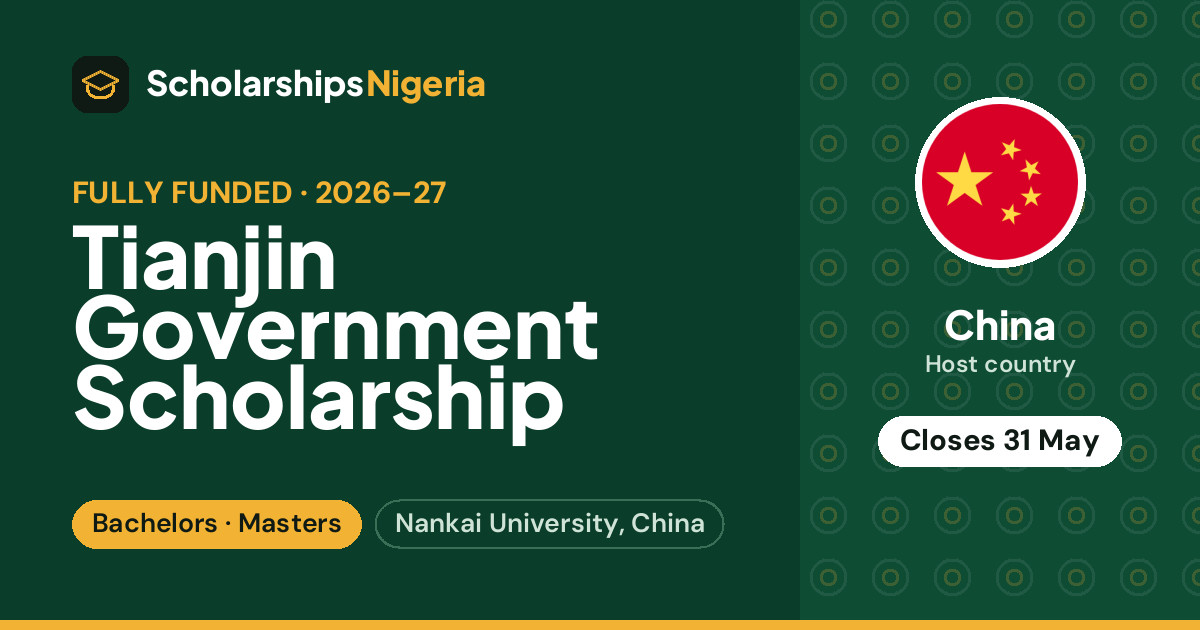
The busiest months are May (3 awards), then April (1) and July (1). May is the month to watch. Two awards close on the same day, 31 May, which means two full document sets due at once. If you are applying to both, your transcripts, recommendation letters and English test need to be in hand well before that date, not requested in that week.
The five dated awards closing soonest are:
One more award on the list runs on a window rather than a single date: the Shanghai Government Scholarship (SGS) Fully Funded 2026 - 2027 accepts applications between January and June of each year. That is a five-month window, which sounds generous until you remember that the universities inside the scheme set their own internal cut-offs earlier than the window closes.
Fields of study
The eight awards span eight subject areas, with 3 awards in each: Agriculture, Arts & Humanities, Business & Management, Economics & Finance, Education, Engineering, Law, and Medicine & Health Sciences.
Medicine and Engineering are the two that most Nigerian applicants ask about, and both are represented. Agriculture at 3 awards is worth a second look if you are coming from a Nigerian background in agricultural science or want a field where Chinese universities have strong facilities and the competition from other international applicants is thinner than it is for Medicine.
What to do next
Start with the admission offer, not the scholarship. Three of these eight awards require it before they will consider you, and the ones that do not still expect you to name a programme and a university. Open the award pages, note which ones ask for an admission offer first, and begin those university applications now.
Then sort your documents by cost and by time. Transcripts and courier fees from Nigeria take weeks, not days. Recommendation letters need a lecturer who is actually reachable. If an award requires IELTS or TOEFL, book the test before you need the score, because the result takes time to reach you. If an award does not state an English test requirement, email the admissions office and ask what they will accept in its place.
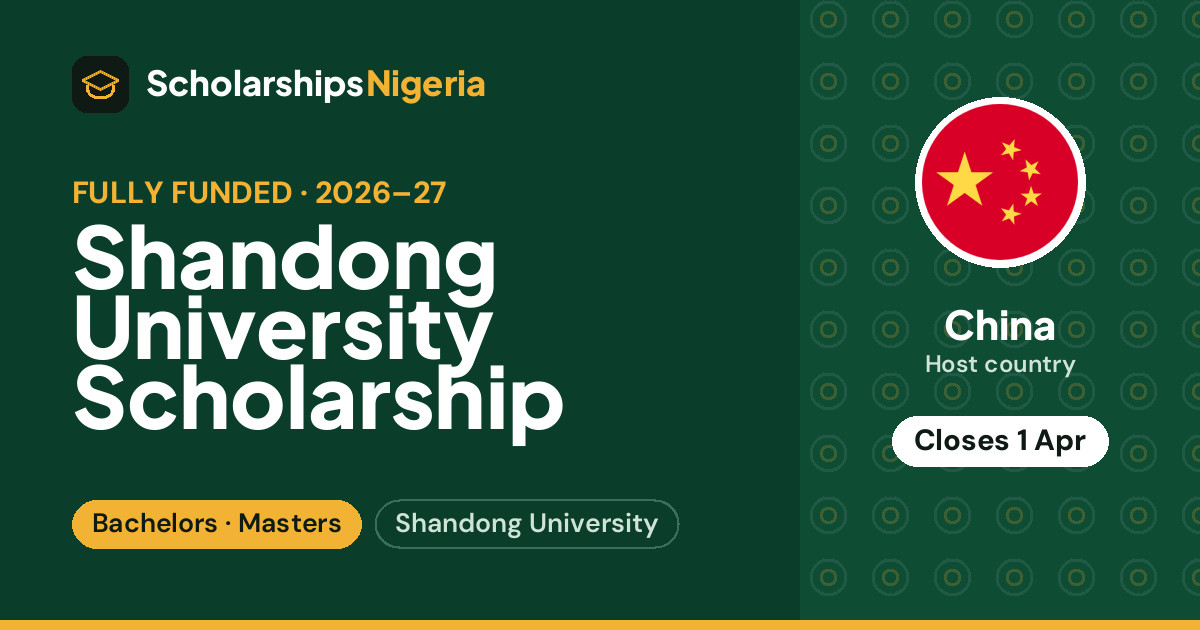
Finally, work backwards from the deadline. For the two awards closing on 31 May, your complete file should be assembled by the end of April. For Shandong on 1 April, it should already be moving. The awards are fully funded and open to you; the only variable you control is whether your paperwork arrives on time.