What this page lists
This page collects 8 masters scholarships in Canada open to Nigerian students. Every award here sits at masters level, and every one is based at a Canadian institution. The providers named on the list include McGill University, the University of Waterloo, Université de Montréal, The University of Winnipeg, the University of Saskatchewan and Humber College in Toronto.
Canada is not a small destination for Nigerian postgraduates. The UNESCO Institute for Statistics recorded 12,072 Nigerian students in Canada in 2023, the third-largest national group in the country. That number covers all levels of study, but it tells you the pathway is well worn and the paperwork is familiar to admissions offices.
What the awards pay for
Funding labels vary across the eight. 4 are marked fully funded and 1 is marked partially funded. The remaining awards do not state a funding label on the page, so treat their value as something you must confirm directly with the university before you build a budget around it.
Where awards spell out what they cover, the detail is thin: 2 name tuition and 1 names travel. That is what those particular awards say in writing, not a description of the whole list. For any award you shortlist, read the official terms for stipend amounts, living costs, health cover and whether the funding runs for one year or the full programme.
Programme lengths appear on two of the listings: one gives 4 years for a PhD and 3 years for a master's, and another gives 4 years for an undergraduate and 2 years for a master's. Masters funding in Canada is often renewed annually rather than guaranteed for the whole degree, so check the renewal conditions.
Can a Nigerian applicant qualify?
On 5 of the 8 awards, Nigerians may apply. None of those five names Nigeria or the African region in its eligibility text; all five simply carry no nationality restriction. The other three do not state eligibility on the award page at all, which means you have to ask the department or the graduate school before you spend money on an application.
The qualification you are bringing is a first degree or an HND — B.Sc, B.A, B.Eng, LLB, MBBS or HND. These awards sit at masters level, covering both taught and research masters. Where an award states a minimum class of degree, the wording is usually "upper second", which corresponds to Second Class Upper (2:1) on a Nigerian transcript. Whether an HND is accepted in place of a degree is decided by each university, not by this page.
What the applications ask for
The requirements stated across the list are worth reading before you start gathering documents, because they set your timeline.
- Letters of recommendation — stated on 4 awards
- A minimum degree class — stated on 1 award
- A research proposal — stated on 1 award
- An admission offer first — stated on 1 award
Four awards asking for reference letters is the single biggest logistical item on this page. Nigerian referees are usually willing, but they are slow, and some universities now send reference requests by email directly to the referee. Give your referees the award name, the deadline and a copy of your statement well ahead of time. If a research proposal is needed, that is weeks of reading, not an afternoon.
One award requires an admission offer before you can be considered for the funding. That reverses the usual order: you apply to the programme first, wait for the offer, then apply for the money. Plan for that sequencing and do not miss the funding window while waiting on admissions.
Deadlines and how they fall
Deadlines on this list are unevenly documented. 1 award carries a specific date, 1 is still open, 1 recurs, and 7 are undated on the page. February is the busiest month, with one deadline falling in it.
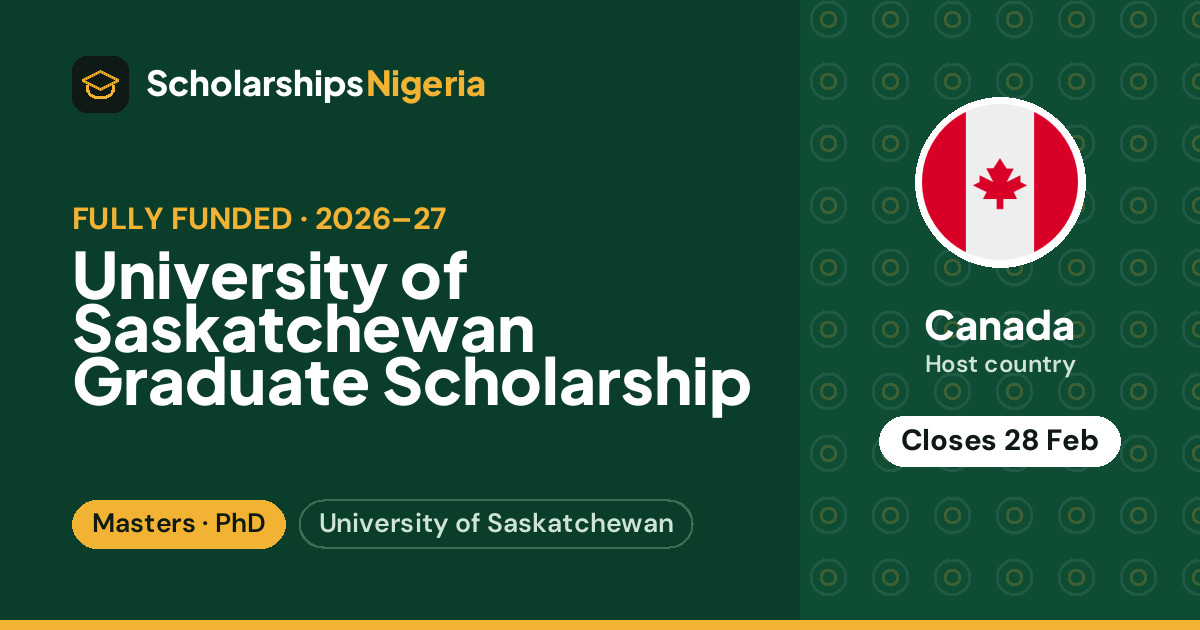
The award closing soonest is the University of Saskatchewan Graduate Scholarship 2026-2027, which closes 28 February. If you are reading this with time in hand, that is the one to work on first.
Others worth opening now: University of Manitoba Graduate Fellowships (UMGF) 2027, where the deadline varies by faculty and you must check your graduate programme's own date; McGill University Scholarships and Fellowships 2026-2027, which follows admission deadlines; University of Waterloo Scholarships 2027; Université de Montréal Scholarships 2027; and University of Winnipeg Scholarships 2026-2027.
Where a deadline is undated, it is usually because the award is tied to the university's admission cycle rather than a standalone funding round. That means the funding deadline is the programme deadline. Find the programme page, note the date, and work backwards.
Fields of study
Only three awards on this page name a field in their own text: Arts & Humanities (1), Business & Management (1) and Social Sciences (1). The rest do not restrict by subject on the listing, which in practice means the department decides. If your field is not named, that is not a closed door — it means you check with the department.
What to do next
Start with the Saskatchewan award, since it has a stated date and it is the nearest one. Then work through the other five listings above and pull three things from each: the funding label, the eligibility wording, and the deadline as the university states it.
In parallel, order your documents. Transcripts from Nigerian universities take time, and courier costs are yours. Ask for your reference letters early, in writing, with the deadline included. If an award needs a research proposal, begin the reading now rather than after you have shortlisted.
Finally, confirm the two things this page cannot confirm for you: whether your class of degree meets the stated minimum, and whether the award accepts an HND. Both answers come from the university, and both are worth an email before you pay any application fee.