What this page lists
This page collects 11 masters scholarships in China that are open to Nigerian students. Every one of the 11 is labelled fully funded by the award itself. That is the headline, and it is also the reason the list is short: Chinese universities tend to run one large flagship funding scheme per institution rather than scattering small bursaries, so what you see here is a set of named university scholarships rather than a long tail of partial awards.
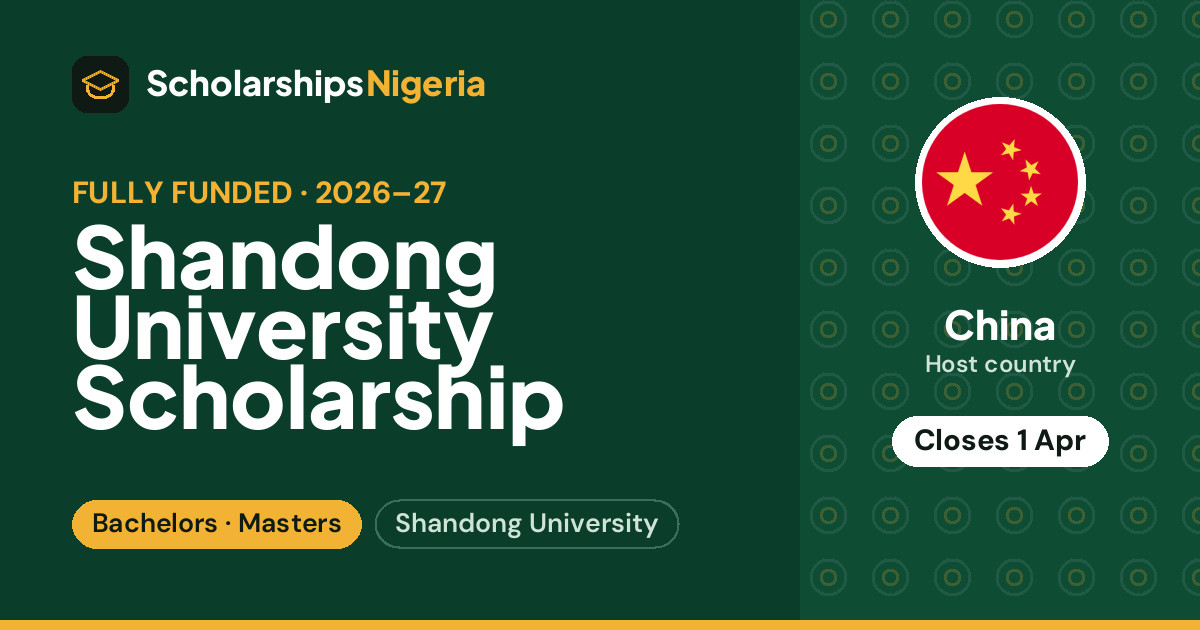
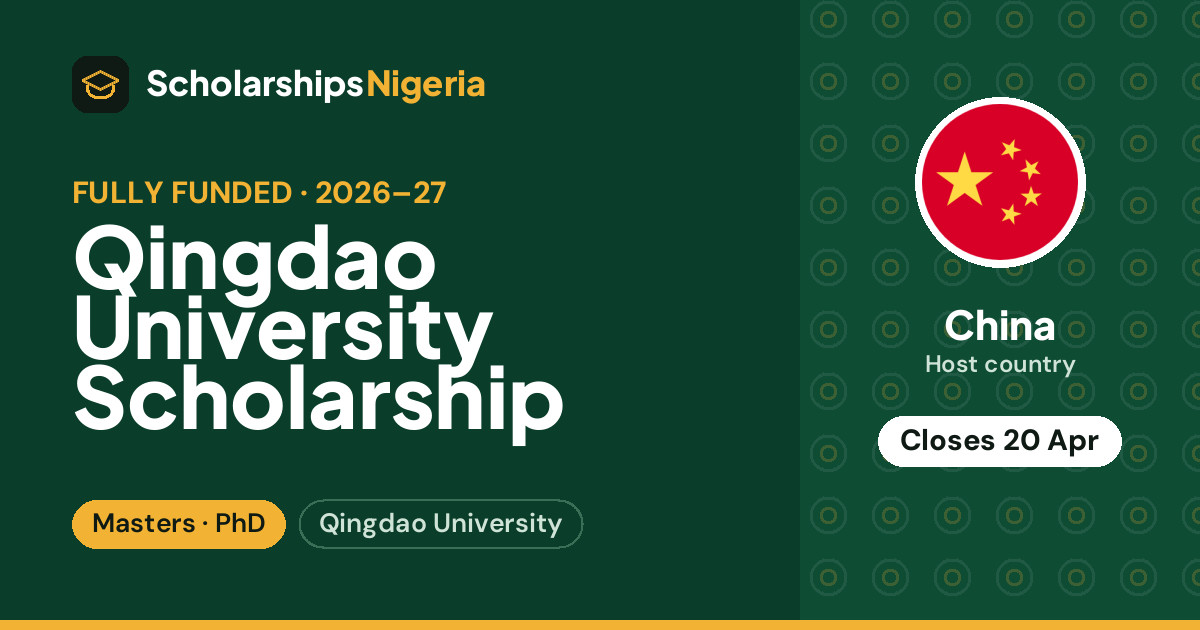
The awards come from institutions including Peking University, Shandong University, Central South University, Yangzhou University, Qingdao University, and grouped listings for universities in Shanghai and Beijing. Nine of the 11 also appear on our PhD listings, and eight appear on our bachelors listings, which tells you something useful: many Chinese universities fund all three levels through the same application portal and the same committee. If you are applying for a masters and a sibling is applying for a first degree, you may end up submitting through one system.
Who can apply
Nine of the 11 awards are open to Nigerian applicants. None of those nine names Nigeria or the African region specifically in its eligibility text; they are open because they carry no nationality restriction at all. That distinction matters when you read the fine print. An award that says nothing about nationality is not the same as an award that says "open to all countries" — but in practice, both mean the same thing for you: you are not excluded by passport.
For the remaining two awards, the eligibility is not stated on the award page. That is not a refusal. It means the page does not tell us either way, and you should treat the university's own call document as the authority before you spend money on a courier.
On qualifications, the pathway is straightforward. You hold a first degree or HND — B.Sc, B.A, B.Eng, LLB, MBBS or HND. Awards usually state a minimum class of degree, and where they say "upper second", that corresponds to Second Class Upper (2:1) on a Nigerian transcript. Whether an HND is accepted is decided by each university, not by us, so check the individual award page rather than assuming.
What the awards pay for
Because all 11 are fully funded, the question is not whether they pay, but what each one names in writing. Of the 11:
- Tuition — named by 7 awards
- Living costs — named by 6
- Accommodation — named by 6
- Health insurance — named by 6
- Travel — named by 2
- Research or training costs — named by 1
Read that list carefully. "Fully funded" is the label the award applies to itself, and the components above are what the award text actually spells out. Tuition is the most commonly named benefit, which is expected. Travel is named by only two awards, so if you are budgeting for a one-way ticket from Lagos or Abuja, do not assume it is covered. The same applies to research costs — one award names them, so a thesis-heavy programme may leave you paying for fieldwork, lab consumables or conference attendance yourself.
Where an award does not name a benefit, we are not saying it withholds it. We are saying the page does not state it. Ask the university directly.
What the applications demand
The requirements are consistent enough to plan around. Across the 11 awards:
- Letters of recommendation — required by 8
- An English test score (IELTS or TOEFL) — required by 7
- A research proposal — required by 3
- An admission offer first — required by 3
- Work experience — required by 1
Two of these deserve attention. First, the English test. Seven awards ask for IELTS or TOEFL, which means booking a test slot, paying the fee, and waiting for the result to reach you before the deadline. If your first degree was taught in English, some universities waive the requirement — but the waiver is granted by the university, and you should confirm it in writing rather than assume it. Do not let a test date become the reason you miss a closing date.
Second, the three awards that require an admission offer first. These are effectively two-stage: you apply to the university, receive an offer, then apply for the funding. That sequence can take months, and it changes your calendar completely. Start those earlier than the ones where funding and admission are decided together.
Letters of recommendation are the most common ask at eight awards. Give your referees at least three weeks, send them your CV and personal statement, and follow up politely. A referee who uploads on the final day is a risk you can avoid.
Deadlines and how they fall
Eight of the 11 awards carry a stated closing date, and all eight are still open. Eight are recurring, meaning the scheme runs again in a later cycle. Three are undated, so you will need to check the award page for the current window.
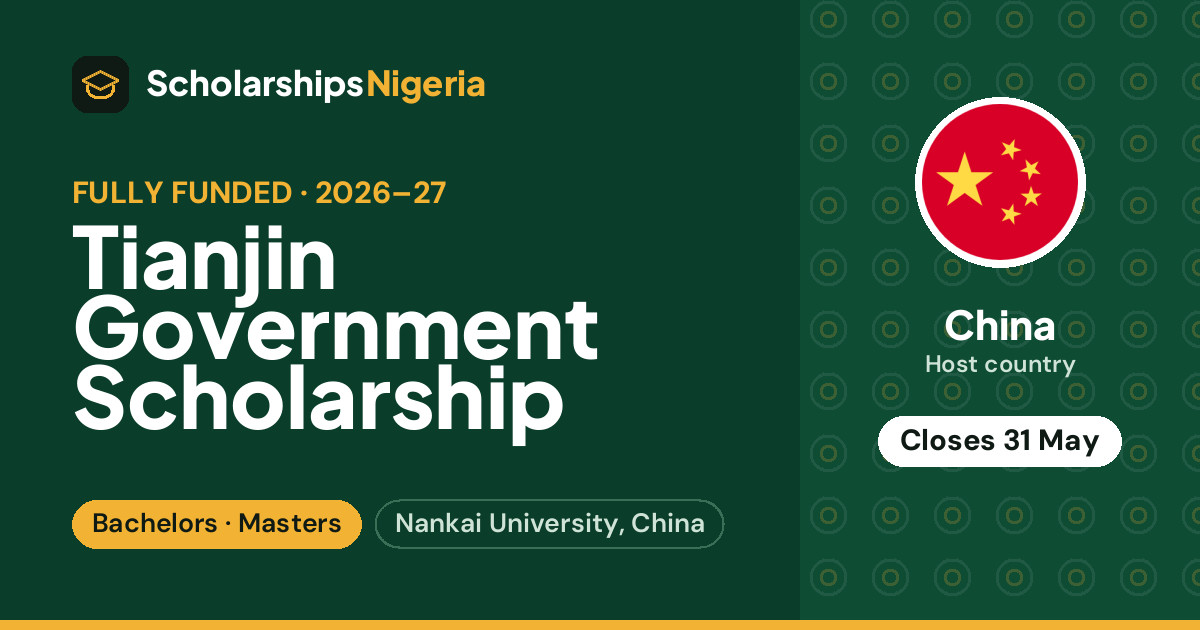
The busiest months are May, with four deadlines, then April with two, and December with one. That spread is helpful: the heavy cluster sits in the second quarter, which gives you the first months of the year to gather transcripts, chase referees and sit an English test if you need one.
The awards closing soonest are:
Note the Yenching deadline. It sits alone in December, well before the April and May cluster, and it is the nearest closing date on this page. If it interests you, it should be your first piece of work, not your last.
Fields of study
The 11 awards are spread across ten subject areas. Arts and Humanities, Business and Management, and Economics and Finance each appear in four awards. Agriculture, Education, Engineering, Law, and Medicine and Health Sciences each appear in three. Public Policy and Development and Social Sciences each appear in one.
That spread is broad enough that most Nigerian applicants will find a match, whether you read History at Ibadan, Accounting at UNILAG, Law at ABU, or Agriculture at FUTA. Engineering and Medicine and Health Sciences sit at three awards each, so competition within those fields may be tighter than the raw subject list suggests.
What the awards are worth
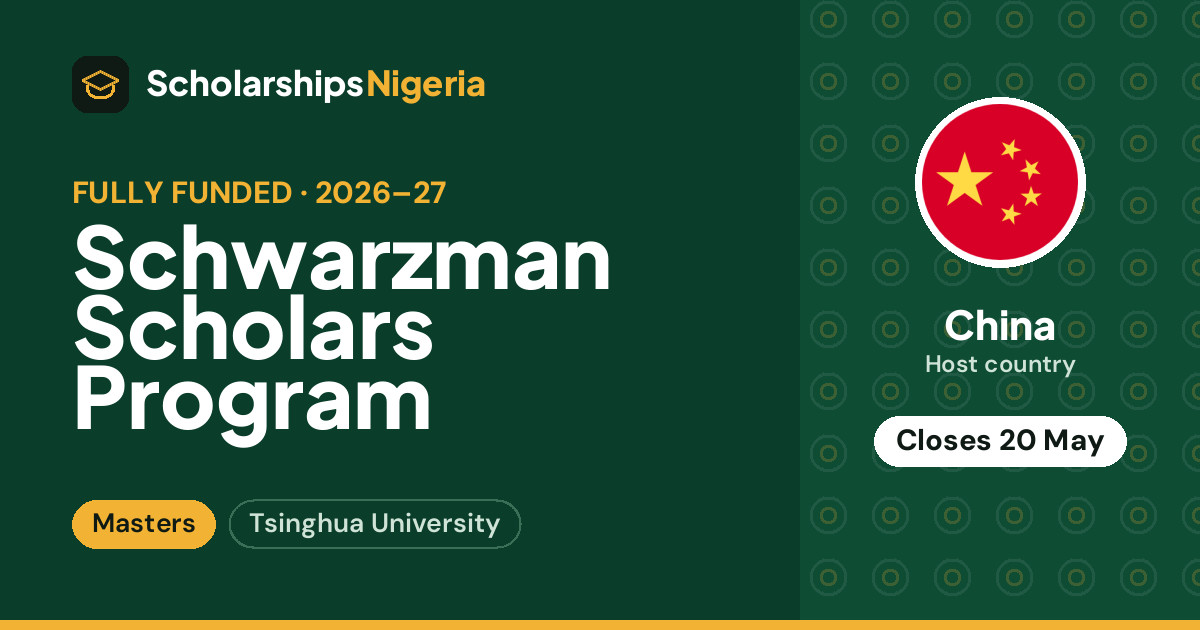
Two awards state the number of places available. The Qingdao University Scholarship lists PhD – 20; Master's – 10. The Schwarzman Scholars Program states up to 140. For the other nine, the number of awards is not stated on the page, so we cannot tell you how many places exist or how competitive each one is. Treat any figure you see elsewhere with caution unless it comes from the university.
Durations vary by institution and level. Where stated, masters programmes run between two and three years depending on the university, with some awards describing a full ladder of bachelor's, master's and doctorate study in one scheme. Check the individual award for the length attached to your programme, because a two-year funding commitment against a three-year degree leaves a gap you will fund yourself.
What to do next
Work in this order. First, decide whether you are targeting the December deadline or the April and May cluster — that single choice sets your whole timeline. Second, open the award pages for the universities that match your field and read the eligibility text yourself, particularly the two awards where eligibility is not stated. Third, sort your documents: transcripts and degree certificates from your Nigerian institution, a valid international passport, and referee commitments. Transcript requests and courier fees cost real money, so request them once and request them early.
Fourth, if an award asks for IELTS or TOEFL, book the test now, not after you have drafted your statement. Fifth, if an award requires an admission offer first, begin the university application immediately, because that stage cannot be rushed. Finally, keep a single spreadsheet with each award, its deadline, and what it still needs from you. With 11 awards and deadlines spread from December through May, the applicants who succeed are usually the ones who started the paperwork before they felt ready.