What this page collects
This page lists 9 scholarships in the natural sciences that are open to Nigerian students. They are not all the same kind of award. Some are for a first degree, some for a master's, most for a doctorate. Some are fully funded, some partial, and three do not label their funding either way in the award text. What they share is the subject area and the fact that a Nigerian applicant is not shut out by nationality.
Natural sciences here means the core science disciplines: biology, chemistry, physics, mathematics, earth and environmental science, and the research fields that sit alongside them. If your background is in engineering or computer science, the counts overlap, but this page is built around the science awards.
Who can apply from Nigeria
All 9 awards on this list accept Nigerian applicants. For 8 of them, no nationality restriction is stated at all, which means the award is open on its own terms and your citizenship is not the barrier. For 1, Nigeria or the wider region is named directly in the eligibility text.
That distinction matters when you are reading the fine print on any award page. An award with no stated nationality restriction still has other requirements, and those requirements are where most applications are lost. Read the eligibility section as a checklist, not as a formality.
What the awards pay for
4 of the awards are labelled fully funded. 2 are labelled partially funded. The remaining 3 do not state their funding level in the award text, so there is nothing on this page to tell you what they cover. Treat those three as unknown until you open the individual award page and read the terms.
Where benefits are named in writing, 2 awards mention tuition and 1 mentions health insurance. Those figures describe what the awards say about themselves. They are not a promise that every cost you will face is covered. A partial award that names tuition may still leave you paying for flights, visa fees, transcripts, courier charges and living costs out of your own pocket.
Levels: where the weight sits
The list leans heavily towards doctoral study.
- PhD: 5 awards
- Bachelors: 3 awards
- Masters: 3 awards
- Fellowship: 1 award
- Postdoctoral: 1 award
- High School: 1 award
Some awards appear under more than one level because they accept applicants at more than one stage, so the numbers above add up to more than 9. If you are finishing an M.Sc and looking towards a PhD, most of this page is aimed at you. If you are coming straight from WAEC or NECO, the three bachelor's awards and the high school award are your entry points.
Countries and providers
The awards sit in seven countries. Australia and the United States each host 2. Canada, Germany, Sweden, the United Arab Emirates and the United Kingdom each host 1.
Providers named on the list include Chalmers University of Technology, Monash University, Queensland University, Berea College, the International Max Planck Research School, and a Canadian institution with a quota to host Vanier scholars. Where an award is tied to a single university, your admission application and your scholarship application are usually two separate processes running on two separate timelines. Start both early.
What the applications ask for
The requirements stated in writing across these awards break down like this:
- An English test score (IELTS or TOEFL): 5 awards
- A research proposal: 3 awards
- Letters of recommendation: 3 awards
- A minimum degree class: 2 awards
- An admission offer first: 2 awards
- Work experience: 1 award
Two things follow from this. First, the English test is the single most common requirement, so book your test before you need it, not after. Second, the research proposal appears as often as recommendation letters, which tells you that several of these awards are judged on the science you intend to do, not only on your grades.
Where an award asks for an admission offer first, the scholarship clock only starts once a university has accepted you. That can push your real preparation window back by months. Transcripts from Nigerian universities, courier delivery and reference letters all take time, and none of them move faster because a deadline is close.
Deadlines and how they fall
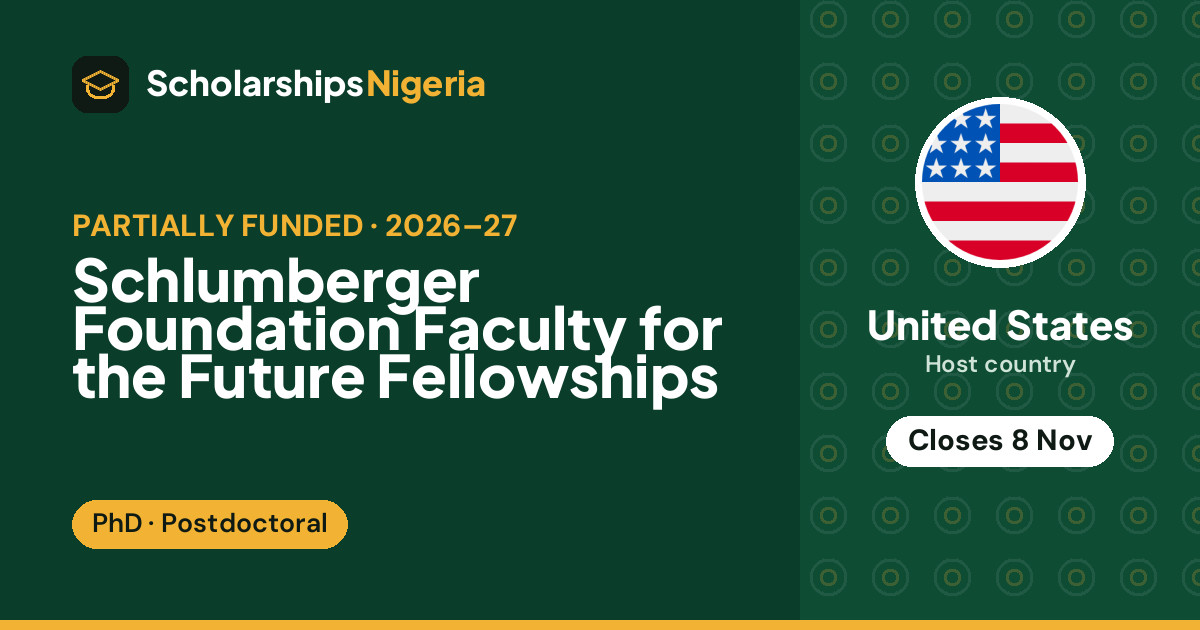
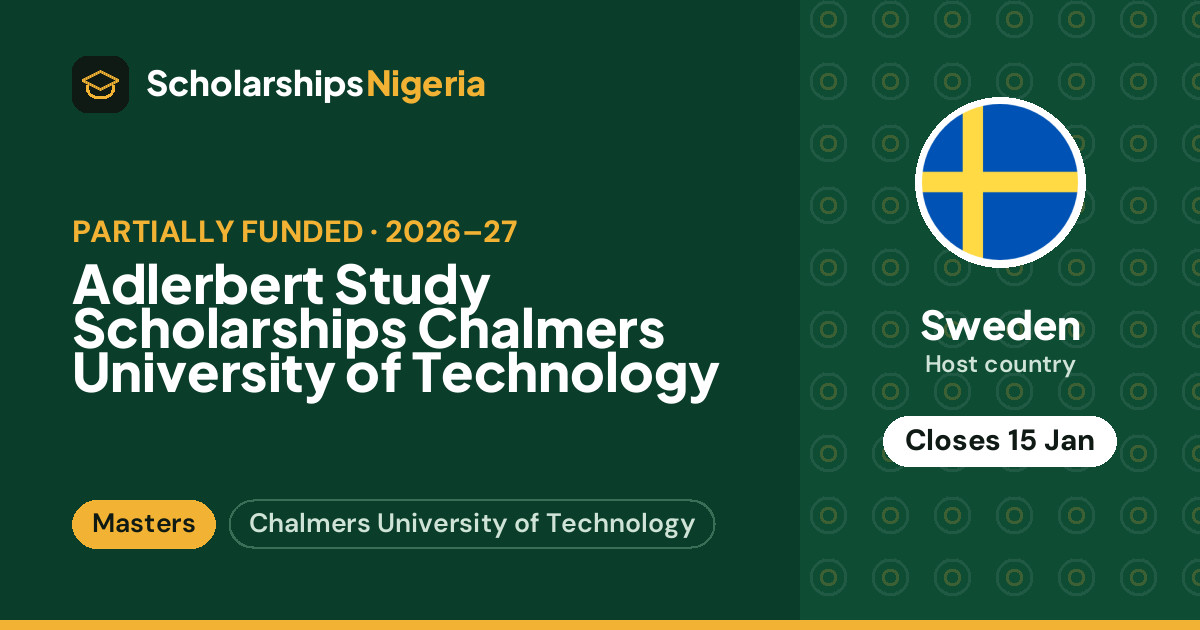
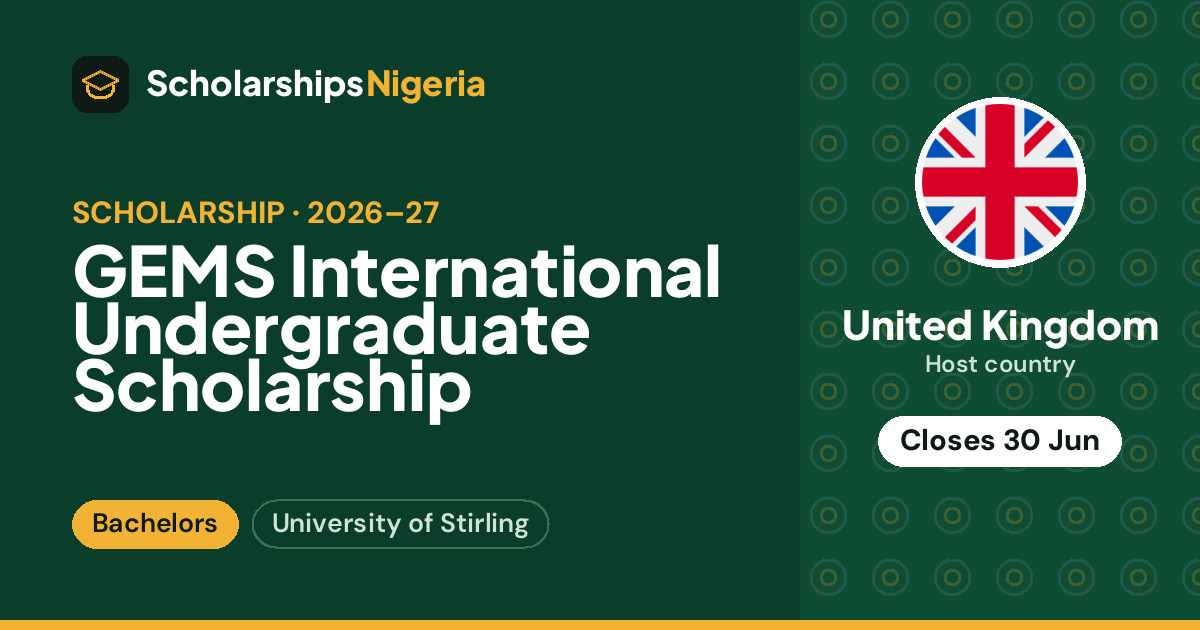
4 of the awards carry a stated date and 4 are still open at the time of writing. 5 are undated and 4 recur, meaning the same award returns on a yearly cycle. The busiest months across the list are January, May and November, with one award falling in each.
The awards closing soonest are:
Two other awards on the list are worth noting for their timing. The Vanier Canada Graduate Scholarship (Vanier CGS) 2027 closes before November 2026, and the University of Queensland (UQ) 2027 award runs its cycle between August and November for the Vice-Chancellor's scholarship. Both are dated by cycle rather than by a single day, so confirm the exact date on the award page before you plan around it.
Where an award is undated, that usually means the provider has not published the next window. It does not mean the award is closed. Check the provider's own page and set a reminder for the month it opened last year.
Durations and award numbers
Where a duration is stated, it ranges widely: 2 awards run for 4 years, 1 runs for 3 years, 1 runs for 1 year, and 1 runs for 4 years or longer depending on the major. That spread reflects the mix of levels on the page. A bachelor's award in the sciences often runs longer than a master's award, and a doctoral award is usually funded for the length of the research programme rather than a fixed teaching year.
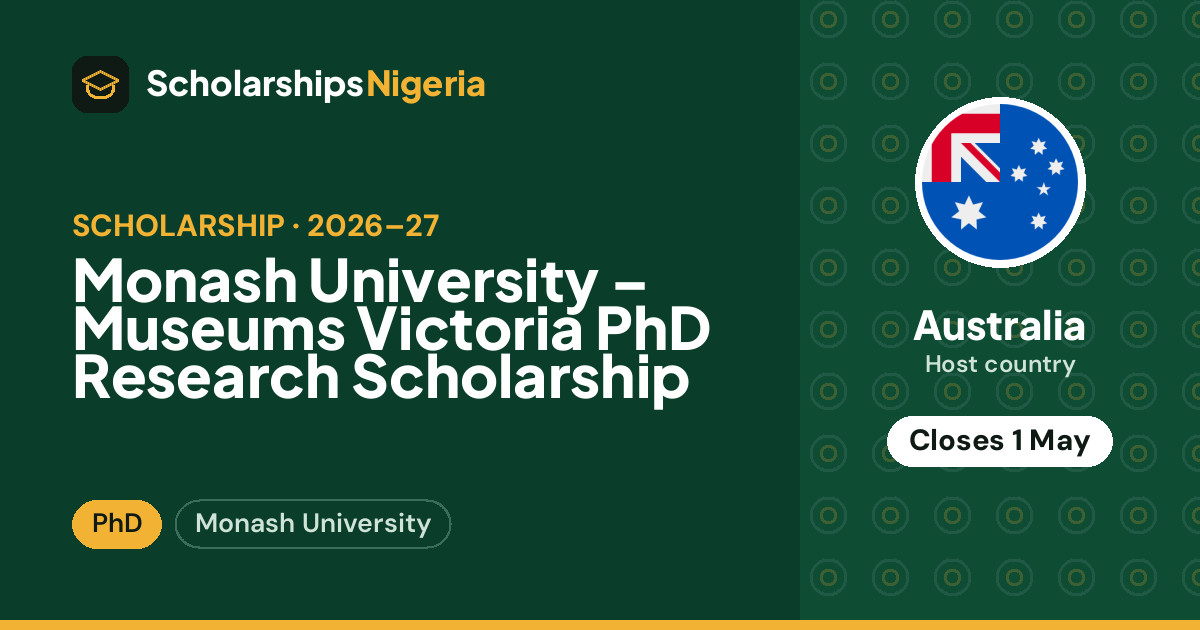
Only 1 award on this list states how many places it offers: the Monash University – Museums Victoria PhD Research Scholarship, at 2 per year. For the rest, the number of awards is not given, so plan on the assumption that the field is competitive and that your application has to stand on its own.
What to do next
Open the four awards with the nearest deadlines first, since those are the ones where a decision this month changes what you can apply for. Read the eligibility text on each award page and mark every requirement you cannot yet meet. An English test score you have not booked, a research proposal you have not drafted, a reference letter you have not requested — each of these is a task with a lead time, and the lead times are longer from Nigeria than the award pages assume.
If you are at the start of the pipeline, look at the bachelor's and high school awards on the list before you look at the doctoral ones. If you are finishing a master's, the five PhD awards are where your application belongs. Then work backwards from the deadline, not forwards from today.