What this page lists
This page collects 7 scholarships in Germany that are open to Nigerian students. Every entry sits in two categories at once: the country is Germany, and the eligibility is open to Nigerian applicants. That is a narrow intersection, and it is the reason the list is short rather than long.
Six of the seven are labelled fully funded by the provider. One award does not state its funding position either way, so nothing on this page tells you what it covers. Treat the six as the ones you can plan around.
The awards come from a mix of German political foundations, a research school, a university and a foundation. The providers named on this page are The Heinrich-Böll-Stiftung, Friedrich Ebert Stiftung, International Max Planck Research School, Studienstiftung des deutschen Volkes, Neufert-Foundation and Constructor University.
Who can apply, and how the eligibility breaks down
All 7 awards on this page accept Nigerian applicants. Of those, 1 names Nigeria or the region in its own eligibility text, and 6 carry no nationality restriction at all. Those two figures add up to the seven, so they are not separate pools you can apply to twice.
The practical difference matters. An award with no nationality restriction is open to you on the same terms as any other international applicant, and your file is judged on its own merits. An award that names Nigeria or the region is speaking to you directly, and you should read its eligibility wording closely before you spend money on transcripts or courier fees.
None of the seven leaves eligibility unstated. Where an award is on this page, the provider has said something about who may apply.
What the awards pay for
Funding labels are one thing; what an award actually covers is another. These are the benefits that appear in the awards' own text:
- Health insurance — named by 3 awards
- Tuition — named by 2 awards
- Living costs — named by 2 awards
- Travel — named by 2 awards
- Research or training costs — named by 1 award
Read that list as what the providers have put in writing, not as a promise that every fully funded award covers all of it. A fully funded label can mean tuition plus a monthly stipend, or it can mean tuition alone. Before you apply, find the award's own benefit section and check whether health insurance, living costs and travel are inside it. For a Nigerian student paying for a blocked account, a flight and a visa out of pocket, the difference between tuition-only and tuition-plus-stipend is the difference between a viable plan and a shortfall.
Levels on this list
The seven awards spread across more than one stage of study, and several cover more than one level at once, so the counts below add up to more than seven.
- Masters — 4 awards
- PhD — 4 awards
- Bachelors — 2 awards
- Fellowship — 2 awards
- High School — 2 awards
- Postdoctoral — 1 award
- Short Course — 1 award
Masters and PhD are the strongest parts of this list, which suits a Nigerian reader holding a B.Sc, an HND or an M.Sc and looking for the next step. The Bachelors and High School entries are fewer but real, and worth checking if you are applying earlier in your academic life or supporting a younger sibling.
Where an award runs for a set period, the durations stated are 4 years, more than 1 year, 1.5 to 2 years, and 2 years. Plan your funding across the full period, not just the first year.
What the applications ask for
Requirements vary, and the counts below show how many awards state each one in their own text:
- Letters of recommendation — 3 awards
- An English test score (IELTS or TOEFL) — 1 award
- A minimum degree class — 1 award
- A research proposal — 1 award
Three awards wanting recommendation letters is the detail that should shape your timeline. Approach your referees early, give them your CV, your transcript and a short note on what you are applying for, and set your own internal deadline well before the provider's. Lecturers in Nigerian universities are handling many such requests at once, and a letter that arrives late is a letter that does not count.
Only one award on this page states an English test requirement. That does not mean the rest waive it. Where a test is not mentioned, check the award's own page and the university's admission rules before you book a test date, because an IELTS or TOEFL fee is money you may not need to spend.
One award names a minimum degree class and one asks for a research proposal. If you are applying at PhD level, start drafting the proposal now; it takes longer than most applicants expect.
Deadlines and how they fall
Two awards on this page carry a stated date, two are still open, and five are undated in the listing. Two are recurring, which means the provider runs them on a cycle and a missed round is not necessarily the end of the road.
The busiest months in this set are March and May, one award each. The two closing soonest are:
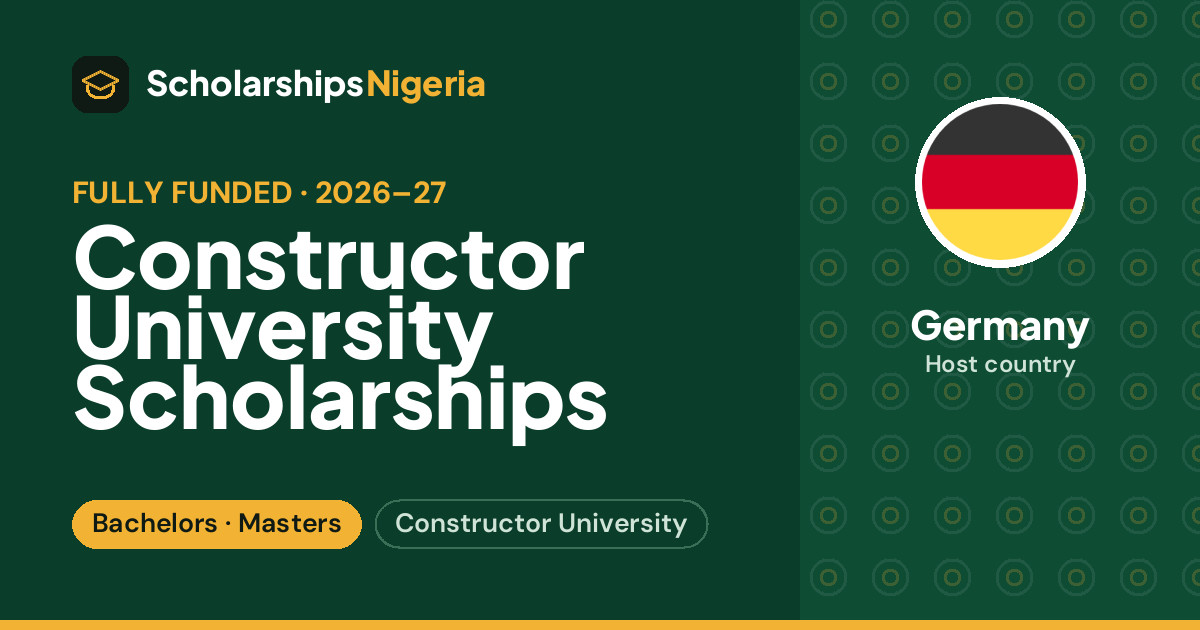
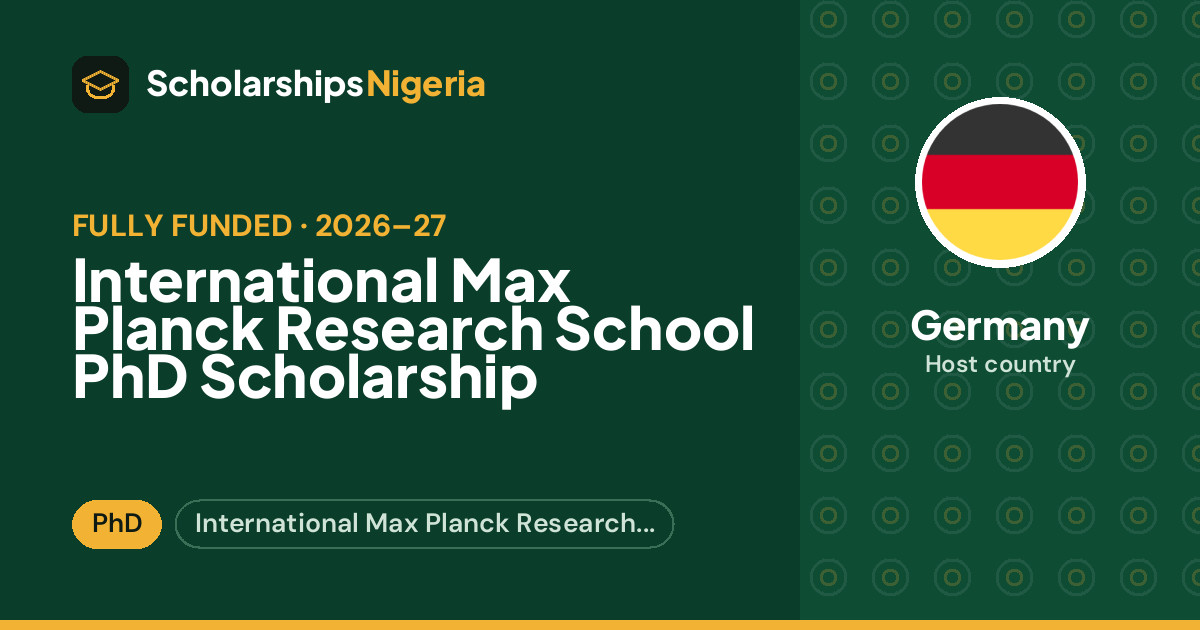
Others run on their own clocks. The Heinrich Böll Foundation Scholarship 2026-2027 lists September 01, 2026 and March 01, 2027. Friedrich Ebert Stiftung Scholarships 2026 gives Masters: April 30, 2026, for the summer semester. The International Max Planck Research School PhD Scholarship 2026-2027 states that applications are accepted at any time, which sounds relaxed but usually means places fill as suitable candidates appear. Constructor University Scholarships 2026-2027 direct you to see details for the deadline.
Two awards do not state a deadline at all. For those, go to the provider's own page and confirm the current round before you commit to anything.
The awards themselves
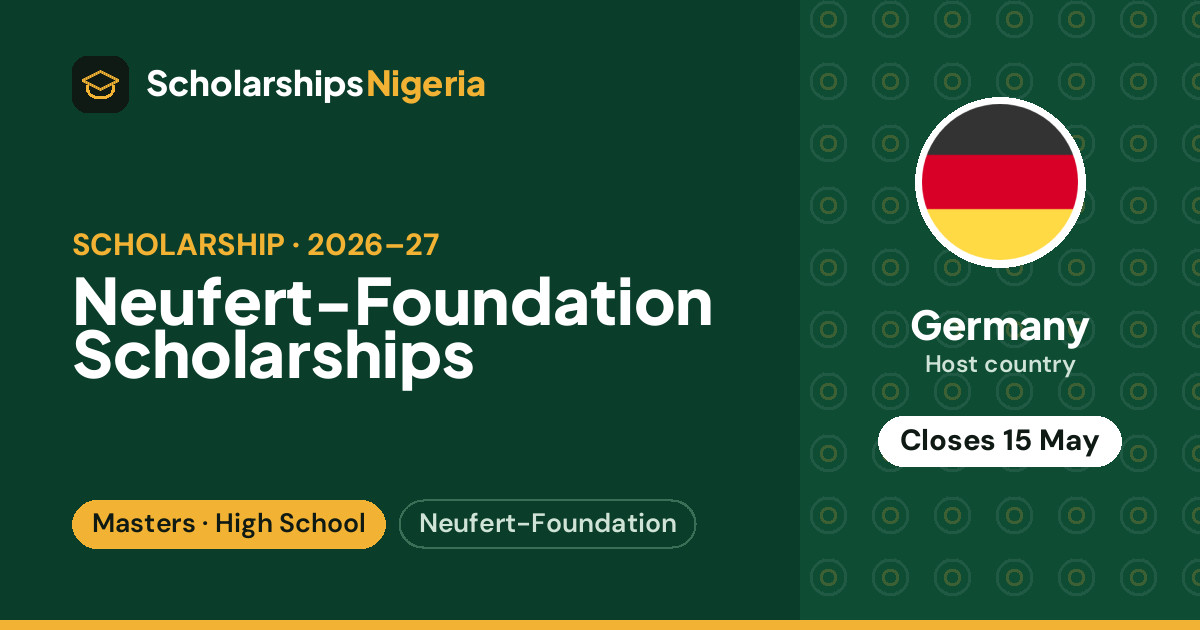
Beyond the two closing soonest, the list includes the Heinrich Böll Foundation Scholarship 2026-2027 for Master's and PhD study, the Friedrich Ebert Stiftung Scholarships 2026 across undergraduate, Masters, PhD and Diploma level, the International Max Planck Research School PhD Scholarship 2026-2027 at doctoral level, and Constructor University Scholarships 2026-2027 for undergraduate and Masters study.
One award on the page states a number of places: Friedrich Ebert Stiftung Scholarships 2026 lists up to 40. No other award here gives an awards count, so do not read silence as either a small or a large number.
By subject, 2 awards sit in Arts & Humanities and 1 in Natural Sciences. Many awards in this set do not restrict by field, so if your discipline is not named, read the individual pages rather than assuming you are excluded.
Why Germany, and what to do next
Germany already hosts a substantial Nigerian student population. The UNESCO Institute for Statistics recorded 3,717 Nigerian students in Germany in 2024, the fourth-largest such group. You would be joining an established community, not starting one.
Start with the two dated awards, since their windows are fixed. Open the Leo Baeck Fellowship page and the Neufert-Foundation page, read the eligibility wording, and note exactly what each one asks for. Then work through the remaining five, checking funding, level and deadline on each.
Build your document pack once and reuse it: transcripts, degree certificate, CV, a statement of purpose you can adapt, and referee details. Order transcripts early, since Nigerian universities take time to process them, and budget for courier costs before you apply rather than after. Where an English test is not required in writing, confirm that in writing too.
Seven awards is a workable list. Read each one properly, apply to the ones that genuinely fit your level and field, and give yourself more time than you think you need.