What this page lists
This page collects 20 scholarships in the United Kingdom that are open to Nigerian students. Every award here is either named for Nigeria or its region, or carries no nationality restriction at all, which means a Nigerian passport is not a barrier to applying. The United Kingdom is the only country represented, so you are looking at one destination, one visa route and one set of university systems rather than a spread of options across several continents.
The list is worth taking seriously for a plain reason: the UNESCO Institute for Statistics recorded 71,756 Nigerian students in the United Kingdom in 2023, the highest number from any single country. That is the queue you are joining. It also means UK admissions offices read Nigerian transcripts constantly and generally know what a Second Class Upper from a Nigerian university means without needing it explained.
Fully funded and partially funded awards
Of the 20 awards, 10 are labelled fully funded and 8 are labelled partially funded. Two do not state their funding level either way, so treat those as unknown until you read the individual award page.
Fully funded does not mean the same thing at every university. What matters is what each award says it pays for, and the counts here are drawn from the awards' own wording:
- Tuition fees — named by 10 awards
- Living costs — named by 6 awards
- Travel — named by 3 awards
- Accommodation — named by 2 awards
- Research or training costs — named by 2 awards
- A settling-in or arrival grant — named by 1 award
Read those figures as what the awards state in writing, not as a promise of a full package. An award that names tuition only will still leave you funding rent, food, the health surcharge and your flight. Before you build a budget around any single award, check whether living costs appear in its own description. If they do not, plan as though you are paying them.
Which study levels are covered
Master's study dominates the list. 15 awards are open at Master's level, which fits the pattern most Nigerian applicants follow: a first degree at home, then a one-year UK Master's. 9 awards are open to Bachelors applicants, useful if you are applying with WAEC or NECO results and no degree yet. 5 are open at PhD level, and there is 1 Fellowship.
Some awards sit at more than one level, which is why the numbers add up to more than 20. Where an award covers both undergraduate and postgraduate study, you apply through the same scheme but against different criteria, so check the level named on the individual page rather than assuming.
Subjects and where the money sits
The subject spread is uneven, and that is useful information. Business & Management appears in 4 awards, the largest single field on the page. Arts & Humanities, Medicine & Health Sciences and Social Sciences each appear in 2. Engineering and Natural Sciences each appear in 1.
If you are an engineer or a scientist, that means fewer named awards and more competition for each one, so widen your search to awards that fund a department rather than a subject. If you are in business or management, you have the most entry points but also the most applicants chasing them.
Do Nigerian applicants qualify?
All 20 awards are open to Nigerian applicants. Within that, 3 name Nigeria or the African region in their eligibility text, and 17 carry no nationality restriction. Those two figures describe the same 20 awards from different angles, not separate pools.
No award on this page leaves its eligibility unstated. That is a good sign for planning: you can read the criteria and know where you stand before you spend money on a transcript or a courier.
The providers behind these awards include University of Oxford (3 awards), plus Westminster university, Sheffield Hallam University, University of Cambridge, Queen Mary University of London and Imperial College London, each with 1. The rest come from other UK institutions listed on the individual pages.
What the applications ask for
The requirements below are counted from what the awards themselves state. They are the documents that decide whether your application is read at all.
- Letters of recommendation — required by 4 awards
- An English test score (IELTS or TOEFL) — required by 3 awards
- A research proposal — required by 3 awards
- An admission offer first — required by 3 awards
- Work experience — required by 2 awards
- A minimum degree class — required by 1 award
Two things follow from this. First, most awards on this page do not state an English test requirement in their own text, but that is not the same as a waiver. A university can still ask for IELTS or TOEFL at admission stage even when the scholarship page is silent. Second, the three awards that want an admission offer first are sequencing traps: you must be admitted before you can be considered for funding, which pushes your real deadline weeks or months earlier than the scholarship closing date.
Letters of recommendation take the longest to arrange in practice. Nigerian academics are asked for these constantly and are often travelling or on strike. Ask four weeks ahead, give your referee your CV, your transcript and a paragraph on what the award funds, and follow up in person rather than by email alone.
Deadlines and how they fall
Of the 20 awards, 7 carry a stated date, 6 are still open, and 13 are undated. 6 recur annually, so if you miss this cycle, the same award is likely to return. The busiest months are May (2 awards), then October (1) and March (1).
The five closing soonest are:
- B.A. Krukoff Fellowship 2026-2027 (Fully Funded) — Queen Mary University of London, closes 31 October, 23 days away
- AfOx Graduate Scholarship 2026-2027 (Fully Funded) — University of Oxford, closes 6 January, 90 days away
- Hatfield Lioness Scholarship 2026-2027 — Durham University, closes 31 March, 174 days away
- Kingston University Scholarships 2026-2027 — Kingston University, closes 10 May, 214 days away
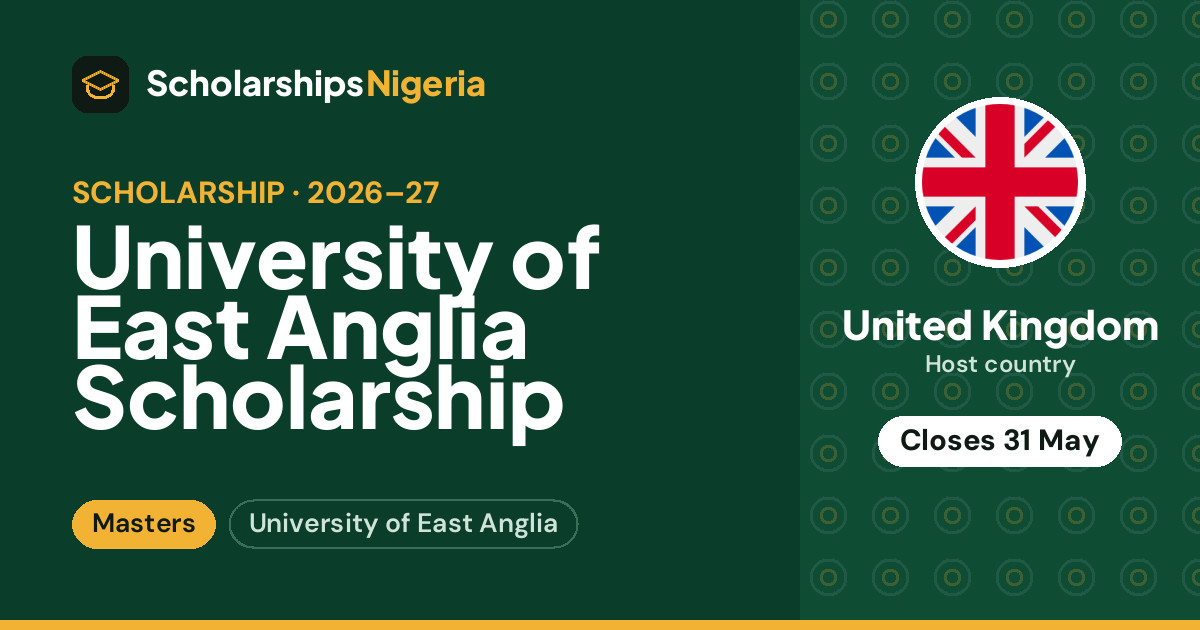
- University of East Anglia Scholarship 2026-2027 — University of East Anglia, closes 31 May, 235 days away
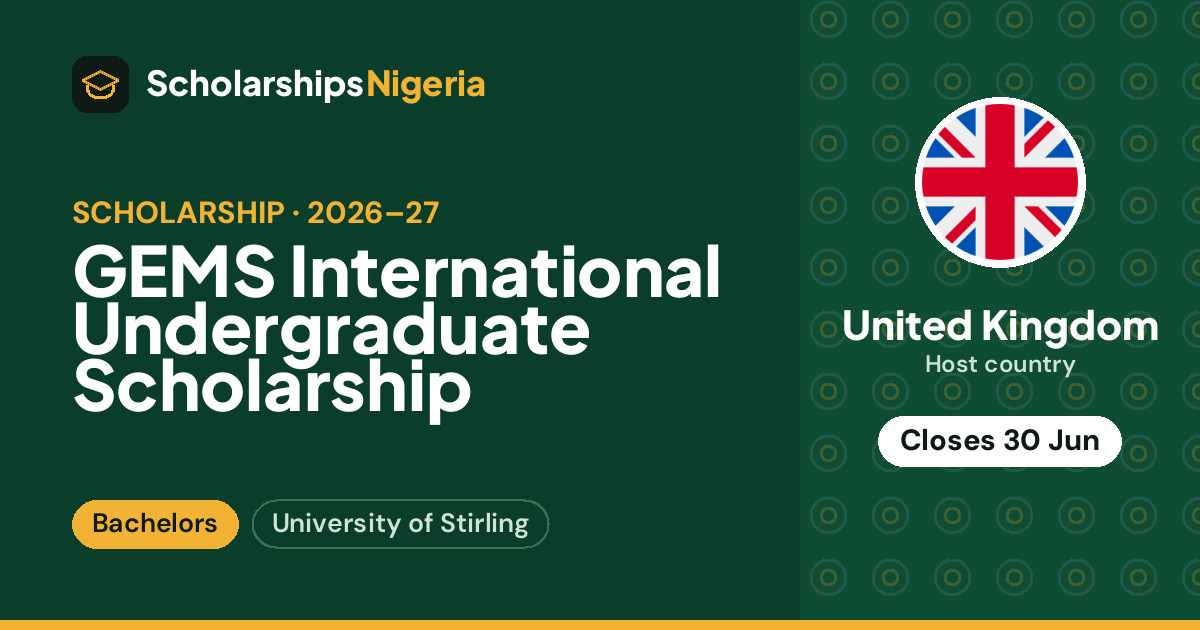
One more sits just outside that group: the GEMS International Undergraduate Scholarship 2026-2027 at the University of Stirling, which closes 30 June.
Notice the shape of the calendar. The Krukoff Fellowship closes in October, before most Nigerian applicants have even requested their transcripts. The AfOx award closes in January. Then there is a gap until the March to June cluster. If you are applying for the 2026-2027 cycle, the October and January deadlines are the ones that will catch you unprepared.
How long the funding runs
Where durations are stated, 4 awards run for 1 year, 1 runs for 3 years, 1 runs for 2 years at Master's or 3 years at PhD, and 1 runs for 3.5 years. The rest do not state a duration on the page.
The one-year awards are almost all Master's programmes, which matches the standard UK postgraduate structure. If you are applying at PhD level, the multi-year awards are the ones that matter, because a single year of funding will not carry you to submission.
What to do next
Start with the two deadlines that fall before the end of January. Open the Krukoff Fellowship and AfOx pages, read the eligibility text in full, and note whether either asks for an admission offer before you can be considered. If it does, your first task is the university application, not the scholarship form.
Then work through the rest of the 20 with a single question in mind: does this award name living costs, or only tuition? Ten awards name tuition and 6 name living costs, so the overlap is where the genuinely usable funding sits for a self-funded Nigerian applicant.
Order your documents now. Transcripts from Nigerian universities take time to produce and longer to courier, and references need chasing. An English test booking, if you need one, should be made before you shortlist awards, not after. The awards with undated deadlines — 13 of them — are not open indefinitely; they simply have not published a date on the page, so confirm directly with the provider before you plan around them.