What this page lists
This page collects 2 scholarships open to Nigerian students for study in Japan. Both are labelled Fully Funded by the bodies offering them. Both are in Japan itself, and both are open to Nigerian applicants.
That is a small list. It is small because it is filtered twice: the award must be in Japan, and it must be one a Nigerian can apply for. If you are searching broadly, treat this page as a starting point rather than a full picture of Japanese funding.
Who can apply, and on what grounds
Neither of the two awards names Nigeria, or West Africa, in its eligibility text. Both are open because they carry no nationality restriction at all. That is the cleaner kind of eligibility: you are not relying on a regional quota or a bilateral agreement that may or may not include Nigeria this cycle. You are relying on the award being open to international applicants generally.
Read that carefully before you plan around it. An award with no nationality restriction still has every other requirement — degree class, subject fit, host university, referee reports. Openness to Nigerians is not the same as a short application.
What the awards pay for
Both awards state that they cover tuition and living costs. Both also state that they cover travel. One of the two states that it covers accommodation.
Those are the benefits the awards name in their own text. They are what the award says it provides, not a promise about what you will receive after selection. Funding bodies adjust, and the final letter is the document that matters. When you apply, ask the contact named on the award page what the monthly or termly figure actually is, and whether travel means one return ticket or an annual one.
Levels of study
The two awards between them cover three levels:
- Master’s — both awards
- PhD — both awards
- Bachelors — one award
So a Nigerian graduate with a B.Sc or HND, or an M.Sc holder heading for a doctorate, is looking at the same short list. The undergraduate route exists on this page but only through one award.
Durations stated by the awards run as follows. One states undergraduate study of 4–5 years, master’s of 2–3 years, and a PhD of 3–4 years. The other states a master’s of 1.5–2 years and a doctorate of 3–4 years. Plan your funding and your living arrangements against the longer figure, not the shorter one.
What the applications demand
Across the two awards, the stated requirements are:
- An English test score (IELTS or TOEFL) — one award
- A minimum degree class — one award
- Letters of recommendation — one award
These are the requirements the awards write down. Where an award does not state a requirement, that does not mean it has none — it means the page does not say. Check the award’s own documents before you assume a waiver.
For a Nigerian applicant, the practical points are these. If the English test is required, book early: test dates in Nigeria fill up, and results take time to reach Japan. If a minimum degree class is stated, read it against the Nigerian wording on your transcript — a Second Class Upper, a Second Class Lower, an HND distinction — and ask the admissions office directly how they read your classification rather than guessing. For recommendations, approach your referees with your research proposal or statement in hand, and give them weeks, not days. Transcripts and courier costs are yours to carry, so start the paperwork before you know whether you have been shortlisted.
Deadlines and how they fall
Of the two awards, one has a date and one does not. One is still open. One recurs. The busiest month on this page is November, with one deadline falling in it.
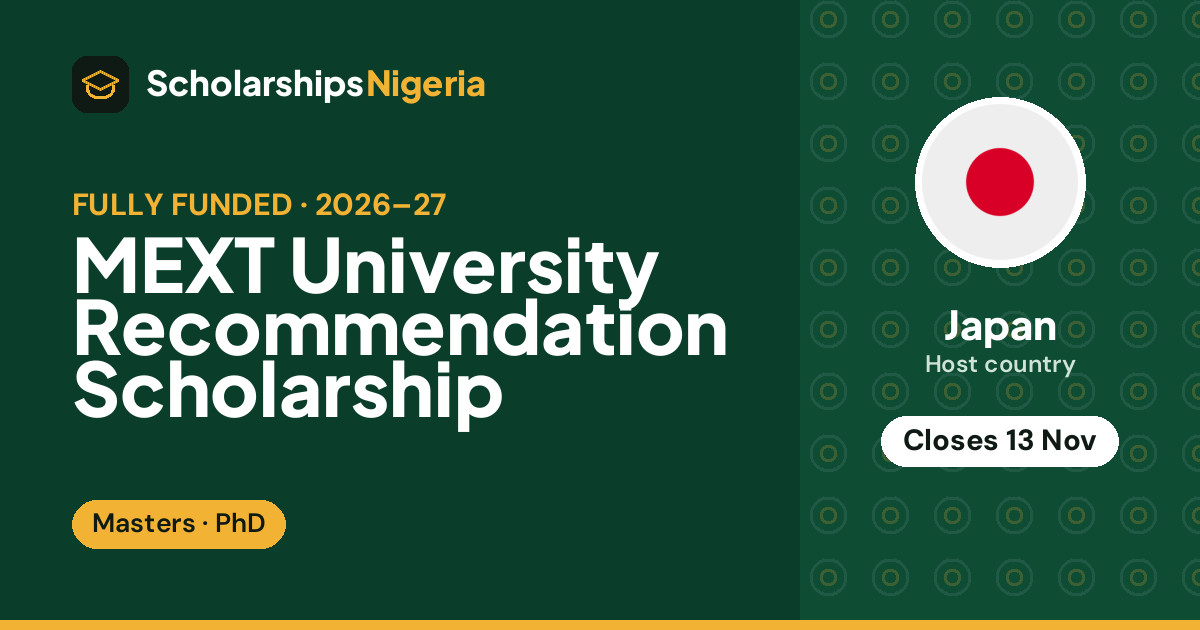
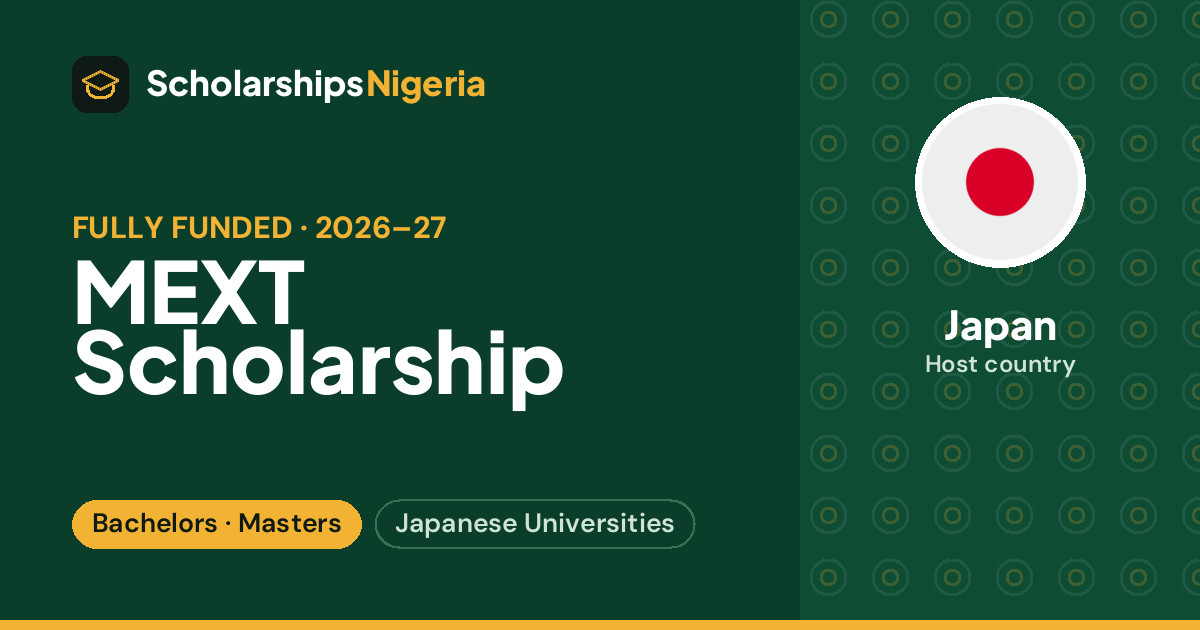
The award closing soonest is the MEXT University Recommendation Scholarship 2026-2027, offered through Ritsumeikan Asia Pacific University (APU), for Master’s and PhD study. It closes on 13 November. The other award on this page, MEXT Scholarship 2027 (Fully Funded), is offered through Japanese universities and covers undergraduate, Master’s, PhD and training routes; its deadline is shown as “see details”, so you will need to open it and read the timing for yourself.
The university-recommendation route is worth understanding because it works differently from applying to the embassy. You apply through the university, and the university puts your name forward. That means your first deadline is internal to that institution, and it can fall well before the date the award page shows. If you intend to go that way, contact the APU office handling the award now, not in November.
Who is offering these awards
One award is offered by Japanese universities. The other is offered by Ritsumeikan Asia Pacific University (APU). Both are in Japan.
There is a reason to note the difference. An award run by a single named university is tied to that university — you must be admitted there, and your application goes through their process. An award run by Japanese universities collectively is usually routed through a national or embassy system, with a different set of steps. Do not treat the two as interchangeable. Read which one you are applying to before you write a single line of your statement.
How many Nigerians study in Japan
According to the UNESCO Institute for Statistics, 198 Nigerian students were studying in Japan in 2023. Nigeria ranked 44th among the countries sending students there.
That is a useful number to hold in your head. Japan is not a crowded destination for Nigerian students. The community is small, and that cuts both ways: fewer people ahead of you in the queue, and fewer people to ask for help with the paperwork once you are there. If you are seriously considering Japan, start looking for Nigerian students already in the country early in the process.
What to do next
Two awards is a short list, so work it carefully rather than broadly.
- Open the MEXT University Recommendation Scholarship 2026-2027 first. It closes 13 November and it is the only dated deadline here.
- Contact APU about the university-recommendation route now, and ask what their internal deadline is — it will be earlier than the published date.
- Open the MEXT Scholarship 2027 (Fully Funded) and read the timing and the level you qualify for. It covers undergraduate, Master’s, PhD and training routes.
- Decide which level you are applying at. Master’s and PhD are covered by both awards; Bachelors by one.
- Check whether the English test applies to your award, and book a date if it does.
- Confirm how your Nigerian degree class reads against any stated minimum, by asking the institution rather than assuming.
- Line up your referees and give them your proposal and enough time to write properly.
- Budget for transcripts and courier fees from your own pocket, and start them early.
There is no shortcut here. Two fully funded awards in Japan, both open to Nigerians, one closing in November. The work is in the documents, and the documents take longer than most people expect.