What this page lists
This page collects 13 high school scholarships that Nigerian students can look at, sorted by study level. High school is the largest single group in this collection: there are 8 PhD awards, 6 Masters awards, 4 fellowships, 4 postdoctoral awards and 3 Bachelors awards listed elsewhere on the site, so the school-level list is the biggest of the six.
Funding is labelled on most of them. 7 are fully funded and 2 are partially funded. Four awards do not state their funding either way, so read each one individually before you spend money on a courier.
The awards come from named providers, including Yale University, the Honjo International Scholarship Foundation, The Heinrich-Böll-Stiftung, the Rosa Luxemburg Stiftung, the Sheikh Saud bin Saqr Al Qasimi Foundation for Policy Research, and a group listed as Canadian Universities.
Where the awards are
The United States carries the largest share, with 6 awards. Germany follows with 3. Australia, Canada, Japan and the United Arab Emirates each account for 1.
That spread matters if you are thinking about cost and distance. A school award in the United States or Canada means a long flight and a student visa process. Germany, Japan and the UAE sit differently on the map and on the wallet, but the eligibility rules differ just as much, so do not choose on distance alone.
By subject, the picture is thin and specific: Social Sciences appears on 2 awards, and Arts & Humanities, Business & Management, Engineering and Natural Sciences each appear on 1. Most school-level awards are not tied to a subject at all, which is normal at this level.
Can a Nigerian student apply?
This is the question to settle first, before you read anything else on an award page. Of the 13 awards here, 5 state that Nigerians may apply. Within that group, none names Nigeria or the region as a restriction, and all 5 carry no nationality restriction at all — that is how the two figures divide up the same five awards, not two separate sets.
The remaining 8 do not state their eligibility on the award page. That is not a refusal. It means the page does not say, and you will have to check the provider's own rules before you assume anything. Treat an unstated eligibility rule as unknown, not as open.
What the awards pay for
Where an award names its benefits in writing, this is what it says. 4 awards mention travel, 3 mention accommodation, 3 mention research or training costs, 2 mention living costs, 1 mentions tuition and 1 mentions health insurance.
Read those as what the award text states, not as a package you are guaranteed. A "fully funded" label and a benefit list are two different things, and the four awards that do not label their funding at all should be checked line by line. Ask the provider directly what is paid to whom, and whether the money comes to you or goes straight to the school.
For a Nigerian family, the gap between a full award and a partial one is the gap between planning and fundraising. If an award covers travel and accommodation but not tuition, the tuition is yours to find. Work that out before the deadline, not after an offer.
What the applications ask for
The requirements named across these awards are mostly documents, and documents take time in Nigeria. 6 awards ask for letters of recommendation, 2 ask for a research proposal, 1 asks for an English test score (IELTS or TOEFL) and 1 asks for a minimum degree class.
Six recommendation letters across the list tells you something practical: your referees are the bottleneck. A teacher or principal who has to write five letters in the same month will write the fifth one badly. Ask early, give them your results and a short written summary of what you have done, and follow up politely.
The single English test requirement is worth noting. Only one award states it in writing, so do not assume every award needs IELTS or TOEFL — but do not assume a waiver either. Where an award does not mention a test, ask the provider whether your WAEC or NECO English result is accepted.
Deadlines and how they fall
8 awards carry a date and 8 are still open. 8 recur, which means the cycle comes round again if you miss it this year. 5 are undated, so there is no closing date to plan around.
The busiest months are November (3 deadlines), May (2) and October (1). November is the month to protect.
Five awards close soonest, and they are worth opening now:
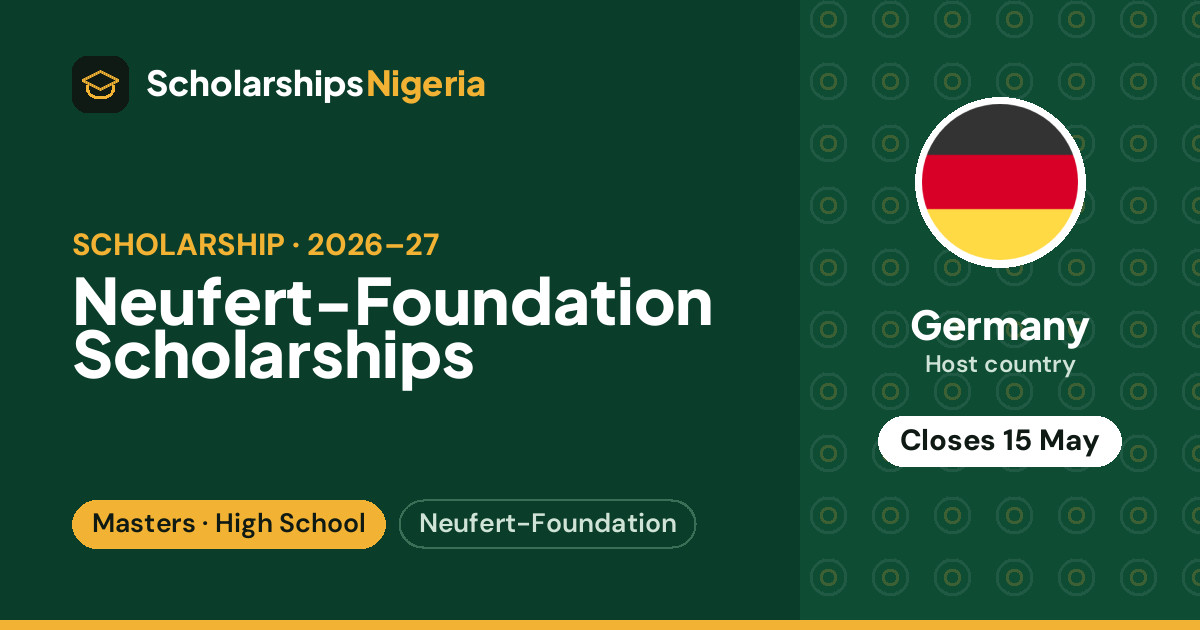
One more example from the list, for a different cycle and country: Neufert-Foundation Scholarships 2026-2027 in Germany closes 15 May.
How long the awards run
Duration is stated on only a few. Where it is given, one award runs 1 to 5 years, one runs up to 3 years for a master's and up to 4 years for a PhD, and one runs for a maximum of 3 years. Most of the 13 do not state a duration on the page, so plan around the award's own terms rather than an assumption.
For a school-level award, the length usually follows the school programme itself. If the award letter does not say how many years are covered, ask before you accept, because a one-year award that quietly ends in year two leaves a bill you may not be able to pay.
What to do next
Start with the five awards closing soonest, because November is the tight month. Open each page, read the eligibility line first, and if it does not state whether Nigerians may apply, email the provider that question before you do anything else.
Then sort the list into three piles: awards that state Nigerians may apply, awards that state no nationality restriction, and awards that say nothing. Spend your effort on the first two piles. Keep the third pile for later, once you have an answer from the provider.
Finally, work backwards from the deadline. Recommendation letters, transcripts and courier delivery all take weeks, not days, and the post from Nigeria is not fast. If an award closes on 1 November, the documents needed to reach it should already be moving.