What this page lists
This collection gathers 9 short course scholarships that a Nigerian applicant can look at. Short course here means study that is not a full degree: exchange semesters, non-degree fellowships, short training programmes and similar. Some of the awards on the page also carry other study levels alongside the short course route, which is why you will see master's, bachelor's and PhD options mentioned in individual entries.
Six of the nine are labelled fully funded. Two are labelled partially funded. One does not state its funding either way, so nothing on this page tells you what that award covers. Treat the label on each individual award page as the thing that matters, not the label on this collection.
Where the awards are
The United States appears three times, more than any other country on the list. Belgium, Canada, Denmark, Germany, Hungary and New Zealand each appear once.
The providers named in the brief include partner U.S. universities, Friedrich Ebert Stiftung, Flemish universities in Belgium, The University of Winnipeg, Hungarian universities and Harrison Middleton University. Fields are thin on the ground: only one award names a field, and that is Arts & Humanities.
Can a Nigerian applicant apply?
Five of the nine awards are open to Nigerians on the face of it. Of those five, two name Nigeria or the region in their own eligibility text, and three place no nationality restriction at all. The remaining four awards do not state their eligibility on the award page, which is not the same as saying you are excluded. It means you have to check the award page or the provider's own rules before you spend money on a transcript or a courier.
That distinction matters. A short course award that is silent on nationality is often administered by a university department or a foundation with its own internal criteria, and those criteria are sometimes only visible on the provider's site. Read the entry, then read the provider's page.
What the awards say they cover
These are the benefits named in the awards' own text, counted across the nine:
- Living costs: named by 7 awards
- Health insurance: named by 6 awards
- Tuition: named by 5 awards
- Travel: named by 4 awards
- Accommodation: named by 3 awards
Read that as what the awards put in writing, not as a promise that every cost you carry will be met. Short course funding often covers a fixed period, and a fixed period means a fixed amount of money. Ask what happens after the covered months end.
What the applications ask for
Across the nine awards, the stated requirements break down like this:
- Letters of recommendation: 4 awards
- An English test score (IELTS or TOEFL): 3 awards
- A commitment to return home afterwards: 2 awards
- A minimum degree class: 1 award
- A research proposal: 1 award
Two things stand out for a Nigerian applicant. First, only three of the nine name an English test. That does not automatically mean the rest waive it, but it does mean the test is not the first thing to budget for. Check each award before you pay for an IELTS slot. Second, the return-home commitment appears on two awards. If you are applying for a short exchange, be ready to explain what you are coming back to.
Letters of recommendation are the most common ask, and they are also the slowest thing to get. Approach your referees early, give them the award name, the deadline and a short note on what you have done since they last taught you. A referee who has three weeks will write a better letter than one who has three days.
How the deadlines fall
Two awards on this page carry a specific date. Two are marked as still open. Seven are undated, and two recur. The busiest months named in the brief are January and November, one award each.
The two closing soonest are worth naming now:
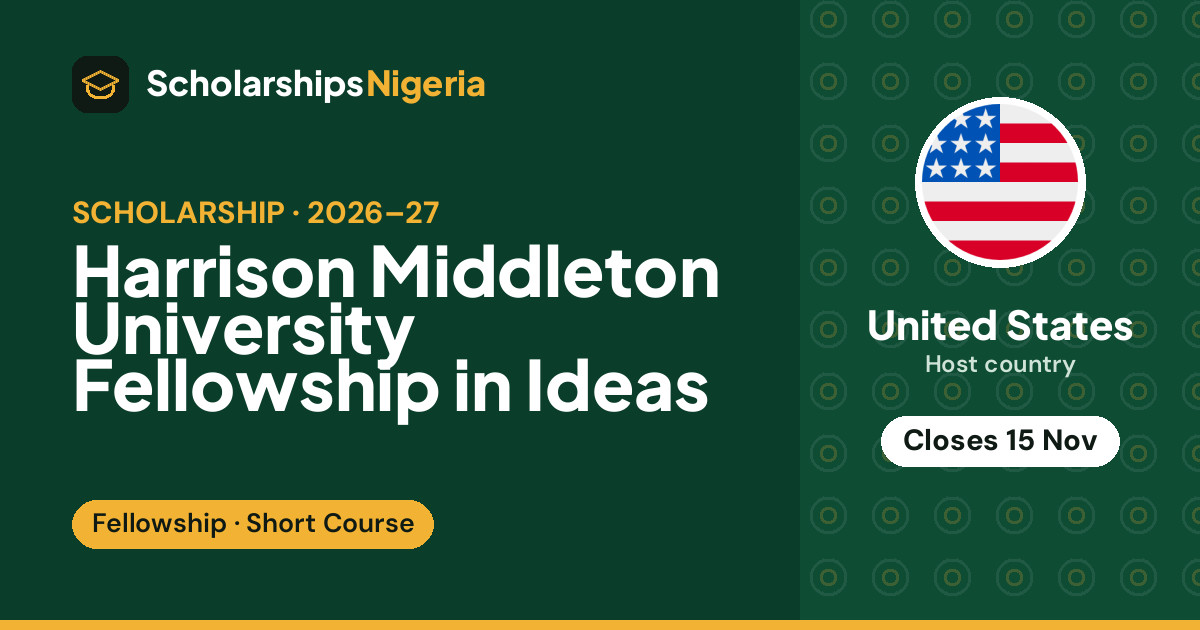
The Hungary award is listed as undergraduate, master's, PhD and non-degree, and is labelled fully funded. The Harrison Middleton award is a non-degree fellowship programme in the United States.
Seven undated awards is the real story here. An award with no stated deadline is not an award with no deadline. It usually means the deadline sits on the provider's page, or that applications are assessed in rounds. If you are working to a plan, treat undated entries as the ones to research first, because you cannot schedule around a date you have not found.
Other entries on the list
Beyond the two above, the page includes the Erasmus+ Scholarship for Study in Denmark, the Global Undergraduate Exchange Program (Global UGRAD) 2027, the Friedrich Ebert Stiftung Scholarships 2026 in Germany and the VLIR-UOS Scholarships 2027 in Belgium.
Their shapes differ. Global UGRAD is an undergraduate non-degree exchange at partner U.S. universities. Friedrich Ebert Stiftung covers undergraduate, master's, PhD and diploma study and states a figure of up to 40 awards. VLIR-UOS is listed as master's and short training programmes at Flemish universities. Erasmus+ in Denmark is listed at master's, PhD and exchange level. Durations named across the page include one semester of four to five months, nine months, and five months.
What to do next
Start with the two dated awards, because those are the two you can plan around. The Harrison Middleton deadline is closer, so if the fellowship fits what you do, that is where your week goes. If it does not, the Hungary award gives you more room and covers several study levels.
Then work through the undated entries and find the real deadlines on the providers' pages. While you are there, confirm two things: whether your nationality is eligible, and whether the funding label on the award matches what the provider actually pays for.
Keep your documents in one place. Transcripts, a current CV, your degree certificate and your referees' contact details should be ready before you open an application, not after. If an award does ask for an English test, you will know early enough to book a date rather than rush one.