What this page lists
This page collects 8 fully funded undergraduate scholarships in China open to Nigerian students. Every award here is labelled fully funded, and every one of the eight is listed at bachelor's level. The same eight providers also run master's and PhD awards, so if you are still deciding how far you want to go, the same universities appear at all three levels.
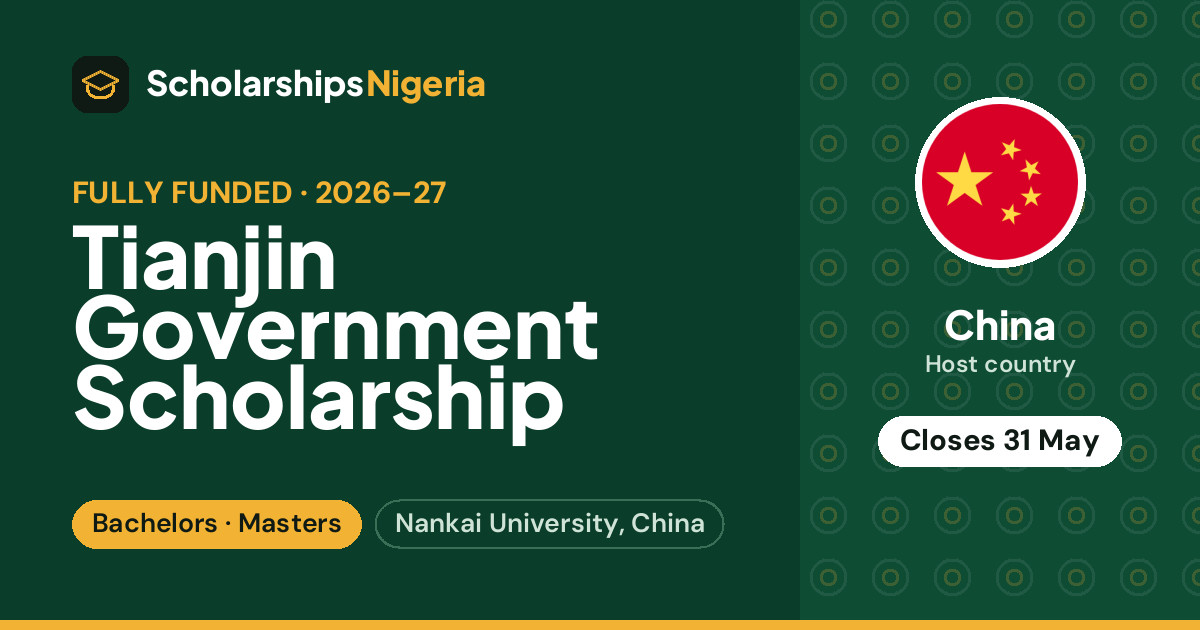
Six providers are named in the list: Shanghai Universities, Beijing Universities, Shandong University, Central South University, Yangzhou University and Nankai University. The remaining entries sit under those provider groupings, which is why the count of named institutions is smaller than the count of awards.
What the awards pay for
"Fully funded" is a label, not a contract. What matters is what each award says in its own text, and the eight here vary.
- Tuition is named by 4 of the 8 awards.
- Accommodation is named by 4.
- Living costs is named by 3.
- Health insurance is named by 3.
- Research or training costs is named by 1.
Read that list carefully before you start comparing universities. An award that covers tuition and accommodation but says nothing about a monthly stipend leaves you funding food, transport, phone data and winter clothing yourself. In a Chinese city, that is a real monthly figure, and it is the part of the budget Nigerian families most often underestimate. Open the individual award page and look for the words that describe the stipend, the accommodation type and the insurance. If a benefit is not written down, do not assume it.
Do Nigerian applicants qualify?
Of the 8 awards on this page, 6 are open to Nigerian applicants. None of those six names Nigeria or a West African region in its eligibility text; all six simply carry no nationality restriction. The remaining 2 do not state their eligibility on the award page at all.
That distinction matters when you are shortlisting. An award with no nationality restriction is the cleaner bet, because nothing in the written criteria excludes you. An award that is silent on eligibility is not a rejection, but it is not a green light either. You will need to confirm with the university's international admissions office before you spend money on a courier.
The route into these awards is your secondary school result. WAEC, NECO, NABTEB and SSCE are the qualifications that lead into a bachelor's programme, and most of these scholarships expect your senior secondary results alongside an admission offer from the university. Each award page quotes its own entry requirement, so treat the general pattern as a starting point and the award text as final.
What the applications demand
The requirements are not uniform, and the paperwork is where most Nigerian applicants lose time. Here is what the eight awards state in writing:
- Letters of recommendation — 5 awards ask for them.
- An English test score (IELTS or TOEFL) — 4 awards ask for it.
- An admission offer first — 3 awards require this before you can apply for the scholarship.
- A research proposal — 2 awards ask for one.
Two things follow from those numbers. First, the English test is not universal here. Four awards want IELTS or TOEFL; the others do not state it, which is worth checking against your own background, particularly if your secondary schooling was taught and examined in English. Second, the admission offer requirement changes the order of operations completely. If the award you want is one of the three that needs an offer first, your university application has to go out months before the scholarship deadline, not alongside it.
Recommendation letters are the most common ask, at 5 of 8. Approach your referees early, give them your CV and your result slip, and be prepared to follow up in person. A letter that arrives after the portal closes is worth nothing.
How the deadlines fall
Five of the eight awards carry a stated date. All five of those are still open. Three are undated, and five run on a recurring cycle, which means the same award returns each year and you can plan around it.
The busiest months are May (3 awards), then April (1) and July (1). If you are working to a single application season, May is the month that will stretch you.
The five closing soonest are:
One further award on the list, the Shanghai Government Scholarship (SGS) Fully Funded 2026 - 2027, runs between January and June of each year rather than to a single date. Treat that window as a deadline in itself.
How long the programmes run
Chinese bachelor's degrees are not three-year programmes. The award pages on this list describe a bachelor's degree as taking 4 to 5 years, with one page giving a range of 4 to 6 years. Master's programmes are described as 2 to 3 years, and doctorates as 3 to 4 years.
Plan your funding and your family's expectations around four or five years, not three. That is the single biggest difference between applying to China and applying to the United Kingdom, and it affects everything from how long you will need accommodation to when you would realistically return home.
What to do next
Work in this order and you will not waste money on documents you cannot use.
- Decide whether you are applying to an award that needs an admission offer first. If it does, the university application starts now, not the scholarship form.
- Book your IELTS or TOEFL only if the award you have chosen is one of the four that asks for it. Confirm this on the award page before you pay the test fee.
- Request transcripts and your WAEC or NECO result verification early. These take time to process, and courier costs add up when you are sending to more than one university.
- Ask your referees for letters well before the deadline. Five of the eight awards want them.
- Check the award text for what is actually covered — tuition, accommodation, living costs, insurance — rather than relying on the phrase "fully funded".
- Confirm eligibility directly with the university if the award page does not state it. Two awards on this list are silent on that point.
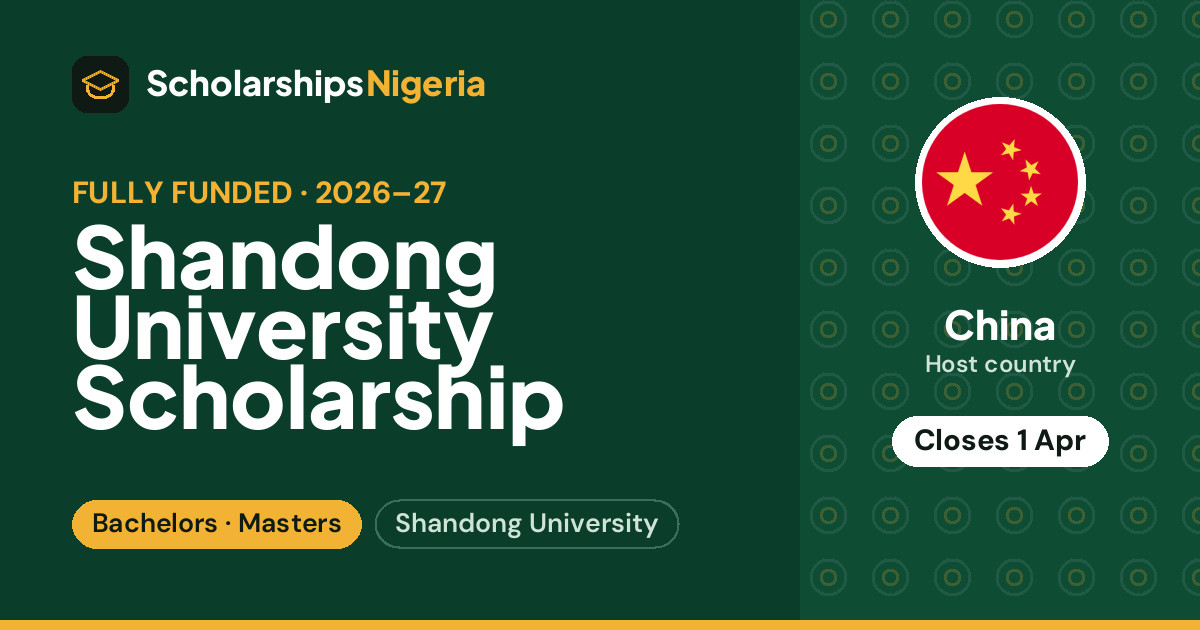
Start with the earliest deadline on the list and work backwards from it. The Shandong award closes 1 April, and everything you need for it — results, letters, possibly a test score — has to be in hand before that date, not on it.